Question
If 5 P(4, n) = 6.P(5, r - 1), find n.

Answer

We have,
5 P(4, n) = 6.P(5, r - 1)
$\Rightarrow 5\times\frac{4!}{(4-\text{n})!}=6\times \frac{5!}{\big[5-(\text{r}-1)\big]!}\ \Big[\because^\text{n}\text{p}_\text{r}=\frac{\text{n!}}{(\text{n}-\text{r})!}\Big]$
$\Rightarrow5\times \frac{4}{(4-\text{n})!}=\frac{6\times5\times4!}{[5-\text{n}+1]}!$
$\Rightarrow \frac{1}{(4-\text{n})!}= \frac{6}{[6-\text{n}]!}$
$\Rightarrow \frac{1}{(4-\text{n})!}=\frac{6}{(6-\text{n})\times(6-\text{n}-1)(6-\text{n}-2)!}$
$\Rightarrow \frac{1}{(4-\text{n})}= \frac{6}{(6-\text{n})(5-\text{n})(4-\text{n})!}$
 $\Rightarrow \frac{(6-\text{n})(5-\text{n})(4-\text{n})!}{(4-\text{n})!}=6$
$\Rightarrow(6-\text{n})\times(5-\text{n})= 6$
$\Rightarrow 30-6\text{n}-5\text{n}+\text{n}^2= 6$
$\Rightarrow \text{n}^2-11\text{n}+30=6$
$\Rightarrow \text{r}^2-11\text{r}+24 = 0$
$\Rightarrow \text{n}^2-8\text{n}-3\text{n}+24=0 $ 
$\Rightarrow \text{n}(\text{n}-8)-3(\text{n}-8)= 0$
$\Rightarrow (\text{n}-8)(\text{n}-3)= 0$ 
$\Rightarrow \text{n}-3 = 0$
$\Rightarrow \text{r}= 3 \begin{bmatrix}\because\text{n}\ \leq\ 4 \\ \therefore \ \text{n}\neq8 \end{bmatrix}$
Hence, $\text{r}= 3$

Need a full question paper?

Generate a complete, print-ready paper with questions like this in minutes — across 16+ boards, with answer keys.
Start Generating Free

Similar questions

A(1, 2, 3), B(0, 4, 1), C(-1, -1, -3) are the vertices of a triangle ABC. Find the point in which the bisector of the angle $\angle\text{BAC}$ meets BC.
Let A = {x, y, z} and B = {a, b}. Find the total number of relations from A into B.
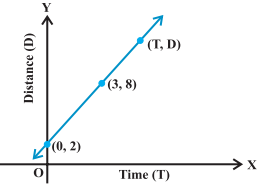
In Fig., time and distance graph of a linear motion is given. Two positions of time and distance are recorded as, when T = 0, D = 2 and when T = 3, D = 8. Using the concept of slope, find law of motion, i.e., how distance depends upon time.

One angle of a triangle $\frac{2}{3}\text{x}$ grades and another is $\frac{3}{2}\text{x}$ degrees while the third is $\frac{\pi\text{x}}{75}$ radians. Express all the angles in degrees.
Let U = {1, 2, 3, 4, 5, 6, 7, 8, 9}, A = {2, 4, 6, 8} and B = {2, 3, 5, 7}. Verify that:
$(\text{A}\cap\text{B})'=\text{A'}\cup\text{B'}$
box contains 6 red marbles numbered 1 through 6 and 4 white marble numbered form 12 through 15. find the probability that a marble drawn is:
  1. White
  2. White and odd numbered
  3. Even numbered
  4. Red or even numbered.
The perpendicular from the origin to the line y = mx + c meets it at the point (-1, 2). Find the value of m and c.
Prove that:
$\frac{\text{cosec}(90^{\circ}+\text{x})+\cot(450^\circ+\text{x})}{\text{cosec}(90^\circ-\text{x})+\tan(180^\circ-\text{x})}\\ +\frac{\tan\text{x}(180^\circ+\text{x})+\sec(180^\circ-\text{x})}{\tan(360^\circ+\text{x})-\sec(-\text{x})}=2$
Solve the following system of equations in R.
$1\leq|\text{x}-2|\leq3$
If the lines 2x - 3y = 5 and 3x - 4y = 7 are the diameters of a circle of area 154 square units, then obtain the equation of the circle.