Question
If 9th term of an A.P. is zero, prove that its 29th term is double the 19th term.

Answer

Given:
$\text{a}_9=0$
$\therefore\text{a}+8\text{d}=0$
$\text{a}=-8\text{d}\ .....(1)$
$\text{a}_{19}=\text{a}+(19-1)\text{d}$
$=\text{a}+18\text{d}$ $[\therefore\text{a}=-8\text{d}\ \text{from}(1)]$
$=10\text{d}\ .....(2)$
$\text{a}_{29}=\text{a}+(29-1)\text{d}$
$=-8\text{d}+28\text{d}$ $[\because\text{a}=-8\text{d}\ \text{from}(1)]$
$-20\text{d}\ .....(3)$
(2) and (3)
$\text{a}_{29}=2\text{a}_{19}$
Hence proved.

Need a full question paper?

Generate a complete, print-ready paper with questions like this in minutes — across 16+ boards, with answer keys.

Start Generating Free

Similar questions

Construct a matrix $A=\left[a_{i j}\right]_{3 \times 2}$ whose elements ay are given by

$a_{i j}=\frac{(i+j)^3}{5}$

Show the following quadratic equation:
$\text{x}^2-(3\sqrt{2}+2\text{i})\text{x}+6\sqrt{2}\text{ i}=0$
Solve the following for $x$, where $|x|$ is modulus function, $[x]$ is the greatest integer function, $\{x\}$ is a fractional part function.

$|x+4| \geq 5$

Find n if,

${ }^{2 n} C_{r-1}={ }^{2 n} C_{r+1}$

Show the following quadratic equation by factorization method:
$17x^2 - 8x + 1 = 0$
If the middle term in the expansion of $\left(x+\frac{b}{x}\right)^6$ is 160 , find $b$.
A party has 20 participants. Find the number of distinct ways for the host to sit with them around a circular table. How many of these ways have two specified persons on either side of the host?
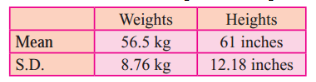
The means and S.D. of weights and heights of 100 students of a school are as follows.

Image

Which shows more variability, weights, or heights?

Two dice are thrown. The events $A, B, C, D, E$ and $F$ are described as follows:
$A$ = Getting an even number on the first die.
$B$ = Getting an odd number on the first die.
$C$ = Getting at most $5$ as sum of the numbers on the two dice.
$D$ = Getting the sum of the numbers on the dice greater than 5 but less than 10.
$E$ = Getting at least $10$ as the sum of the numbers on the dice.
$F$ = Getting an odd number on one of the dice.
Describe the following events:
$A$ and $B, B$ or $C, B$ and $C, A$ and $E, A $or $F, A$ and $F$.
Prove the following : $\frac{\cos x+\sin x}{\cos x-\sin x}-\frac{\cos x-\sin x}{\cos x+\sin x}=2 \tan 2 \mathrm{x}$