MCQ
If A = {1, 3, 5, B} and B = {2, 4}, then:
  • A
    $4\in\text{A}$
  • B
    $\{4\}\subset\text{A}$
  • C
    $\text{B}\subset\text{A}$
  • None of these.

Answer

Correct option: D.
None of these.
$(4\not\in\text{A) }(4\not\in\text{A})$
$\{4\}\not\subset\text{A}$
$\text{B}\not\subset\text{}A$
Thus, we can say that none of these options satisfy the given relation.

Need a full question paper?

Generate a complete, print-ready paper with questions like this in minutes — across 16+ boards, with answer keys.

Start Generating Free

Similar questions

Let $f :(0, \pi) \rightarrow R$ be a twice differentiable function such that

$\lim _{t \rightarrow x} \frac{f(x) \sin t-f(t) \sin x}{t-x}=\sin ^2 x \text { for all } x \in(0, \pi)$

If $f \left(\frac{\pi}{6}\right)=-\frac{\pi}{12}$, then which of the following statement(s) is (are) TRUE?

$(A)$ $f \left(\frac{\pi}{4}\right)=\frac{\pi}{4 \sqrt{2}}$

$(B)$ $f(x)<\frac{x^4}{6}-x^2$ for all $x \in(0, \pi)$

$(C)$ There exists $\alpha \in(0, \pi)$ such that $f ^{\prime}(\alpha)=0$

$(D)$ $f ^{\prime \prime}\left(\frac{\pi}{2}\right)+ f \left(\frac{\pi}{2}\right)=0$
If the equstion $\text{a}_\text{n}\text{x}^\text{n}+\text{a}_\text{n-1}\text{x}^\text{n-1}+...+\text{a}_1\text{x}=0,$ $\text{a}_1\neq0,\text{n}\geq2,$ has positive root $\text{x}=\alpha$ then the eqestions $\text{na}_\text{n}\text{x}^\text{n-1}+(\text{n-1})\text{a}_\text{n-1}\text{x}^\text{n-2}+...+\text{a}_1=0$ has a positive root, which is:
Choose the correct answer. Equation of the line passing through (1, 2) and parallel to the line y = 3x - 1 is:
The eccentricity of the hyperbola $\frac{{{x^2}}}{{16}} - \frac{{{y^2}}}{{25}} = 1$ is
If ${\sum\limits_{i = 1}^{20} {\left( {\frac{{{}^{20}{C_{i - 1}}}}{{{}^{20}{C_i} + {}^{20}{C_{i - 1}}}}} \right)} ^3}\, = \frac{k}{{21}}$, then $k$ equals
If $\forall \mathbf{m} \in \mathbf{N}$, then $11^{\mathrm{m}+2}+12^{2 \mathrm{~m}-1}$ is divisible by:
Exact set of values of $a$ for which ${x^3}(x + 1) = 2(x + a)(x + 2a)$ is having four real solutions is
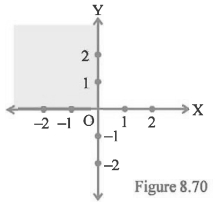
The coloured region in figure 8.70 is the solution set of $\ldots . . . .$
The equation $14{x^2} - 4xy + 11{y^2} - 44x - 58y + 71 = 0$ represents
The length of the latus rectum of the parabola whose vertex is (2, -3) and the directrix x = 4 is: