MCQ
If $a = 2i + 5j$ and $b = 2i - j,$ then the unit vector along $a+b$   will be
  • A
    $\frac{{i - j}}{{\sqrt 2 }}$
  • B
    $i + j$
  • C
    $\sqrt 2 (i + j)$
  • $\frac{{i + j}}{{\sqrt 2 }}$

Answer

Correct option: D.
$\frac{{i + j}}{{\sqrt 2 }}$
d
(d) $a + b = 4i + 4j,$ therefore unit vector $\frac{{4\,(i + j)}}{{\sqrt {32} }} = \frac{{i + j}}{{\sqrt 2 }}.$

Need a full question paper?

Generate a complete, print-ready paper with questions like this in minutes — across 16+ boards, with answer keys.
Start Generating Free

Similar questions

Number of solutions of equation $|x^2 -2|x||$ = $2^x$ , is
Let for $a \ne {a_1} \ne 0,$ $f\left( x \right) = a{x^2} + bx + c\;,g\left( x \right) = {a_1}{x^2} + {b_1}x + {c_1},p\left( x \right) = f\left( x \right) - g\left( x \right),$ If $p\left( x \right) = 0$ only for  $ x=-1 $ and $p\left( { - 2} \right) = 2$ then value of $p\left( 2 \right)$ is
Among all the parallelograms whose diagonals are $10$ and $4$,the one having maximum area has its perimeter lying in the interval
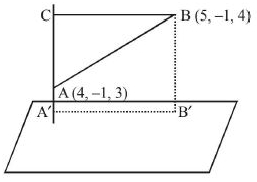
The length of the projection of the line segment joining the point  $\left( {5, - 1,4} \right)$ and $\left( {4, - 1,3} \right)$ on the plane $x + y + z = 7$ is :
The coordinates of the points $A, B, C$ are $({x_1},{y_1})$, $({x_2},{y_2})$, $({x_3},\,{y_3})$ and $D$ divides the line $AB$ in the ratio $l : k$. If $P$ divides the line $DC$ in the ratio $m : k + l$, then the coordinates of $P$ are
Let $g(x) = |   |x + 2| -3|$ . If $'a'$ denotes the number of relative minima, $'b'$ denotes the number of relative maxima and $'c'$ denotes  the product of the zeroes of $g(x)$ , then the value of $(a + 2b -c)$ is 
Let $\overrightarrow{ a }=\hat{ i }+2 \hat{ j }-3 \hat{ k }$ and $\overrightarrow{ b }=2 \hat{ i }-3 \hat{ j }+5 \hat{ k }$. If $\overrightarrow{ r } \times \overrightarrow{ a }=\overrightarrow{ b } \times \overrightarrow{ r }, \overrightarrow{ r } \cdot(\alpha \hat{ i }+2 \hat{ j }+\hat{ k })=3$ and $\vec{r} (2 \hat{ i }+5 \hat{ j }-\alpha \hat{ k })=-1, \alpha \in R ,$ then the value of $\alpha+|\overrightarrow{ r }|^{2}$ is equal to :
Let $a, b, c\, \in \, R $ and $\alpha , \beta$ are the real roots of the equation $ax^2 + bx + c = 0$ and if $a < 0, b > 0, c > 0$ and $\alpha < \beta$ then :-
For which of the following values of $m$, the area of the region bounded by the curve $y = x - {x^2}$ and the line $y = mx$ equals $\frac{9}{2}$
${{x + 1} \over {(x - 1)\,(x - 2)\,(x - 3)}} = $