Question
If A = 30° and B = 60°, verify that.
$\cos(\text{A}+\text{B})=\cos\text{A}\cos\text{B}-\sin\text{A}\sin\text{B}$

Answer

We have,
$\sin(\text{A}-\text{B})=\frac{1}{2}$ and $\cos(\text{A}+\text{B})=\frac{1}{2}$
Now, $\sin(\text{A}-\text{B})=\frac{1}{2}$
$\Rightarrow\sin(\text{A}-\text{B})=\sin30^\circ$
$\Rightarrow(\text{A}-\text{B})=30^\circ\dots(1)$
And, $\cos(\text{A}+\text{B})=\frac{1}{2}$
$\Rightarrow\cos(\text{A}+\text{B})=\cos60^\circ$
$\Rightarrow(\text{A}+\text{B})=60^\circ\dots(2)$
Adding (1) and (2), we get,
$\Rightarrow2\text{A}=90^\circ$
$\Rightarrow\text{A}=\frac{90^\circ}{2}=45^\circ$
Put $\text{A}=45^\circ$ in (2), we get,
$\Rightarrow45^\circ+\text{B}=60^\circ$
$\Rightarrow\text{B}=60^\circ-45^\circ$
$\Rightarrow\text{B}=15^\circ$
Thus, $\text{A}=45^\circ$ and $\text{B}=15^\circ$

Need a full question paper?

Generate a complete, print-ready paper with questions like this in minutes — across 16+ boards, with answer keys.
Start Generating Free

Similar questions

An express train takes 1 hour less than a passenger train to travel 132km between Mysore and Banglore. If the average speed of the express train is 11km/ hr more than that of the passenger train, from the quadratic equation to find the average speed of express train.
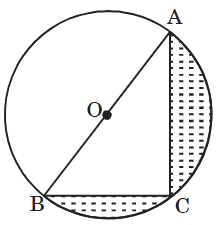
In the given figure, $O$ is the centre of a circle such that diameter $A B=13 \ cm$ and $A C=12 \ cm$. $B C$ is joined. Find the area of the shaded region $($Take $\pi=3.14 )$
Image
Find the greatest number that will divide 445, 572 and 699 leaving remainders 4, 5 and 6 respectively.
Solve the following quadratic equations by factorization:
$3\text{x}^2-2\sqrt{6}\text{x}+2=0$
In $\triangle\text{ABC, PQ}$ is a line segment intersecting AB at P and AC at Q such that PQ || BC and PQ divides $\triangle\text{ABC}$ into two parts equal in area. Find $\frac{\text{BP}}{\text{AB}}.$
Prove that:
$\frac{\cos(90^\circ-\theta)\sec(90^\circ-\theta)\tan\theta}{\text{cosec}(90^\circ-\theta)\sin(90^\circ-\theta)\cot(90^\circ-\theta)}+\frac{\cos\theta\sin(90^\circ-\theta)}{\cot\theta}=2$
The line joining the points (2, 1), (5, -8) is trisected at the points P and Q. If point P lies on the line 2x - y + k = 0, find the value of k.
Each side of a rhombus is $10\ cm$. If one its diagonals is $16\ cm$ find the length of the other diagonal.
150 spherical marbles, each of diameter 14cm, are dropped in a cylindrical vessel of diameter 7cm containing some water, which are completely immersed in water. Find the rise in the level of water in the vessel.
Find the roots of the following equations, if they exist, by applying the quadratic formula:
$2x^2 + x - 4 = 0$