MCQ
If A and B are two events, then $\text{P}(\overline{\text{A}}\cap\text{B})=$
  • A
    $\text{P}(\overline{\text{A}})\text{ P}(\overline{\text{B}})$
  • B
    $1-\text{P}(\text{A})-\text{P}(\text{B})$
  • C
    $\text{P}(\text{A})+\text{P}(\text{B})-\text{P}(\text{A}\cap\text{B})$
  • D
    $\text{P}(\text{B})-\text{P}(\text{A}\cap\text{B})$

Answer

  1. $\text{P}(\text{B})-\text{P}(\text{A}\cap\text{B})$

Solution:

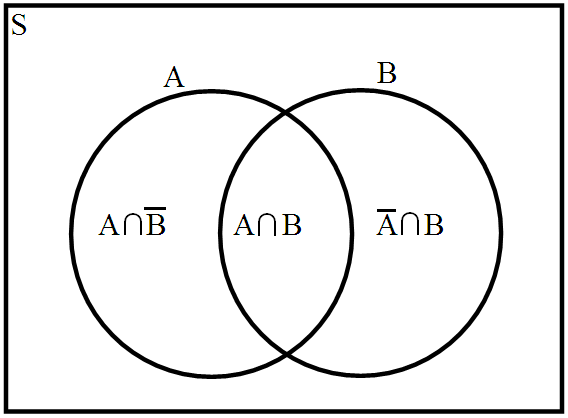
From the diagram, we get $\text{A}\cap\text{B}$ and $\overline{\text{A}}\cap\text{B}$ are mutually exclusive events such that $(\text{A}\cap\text{B})\cup(\overline{\text{A}}\cap\text{B})=\text{B}.$ therefore by

$\text{P}(\text{A}\cap\text{B})+\text{P}(\overline{\text{A}}\cap\text{B})=\text{P(B)}$

$\therefore\ \text{P}(\overline{\text{A}}\cap\text{B})=\text{P(B)}-\text{P}(\text{A}\cap\text{B})$

Need a full question paper?

Generate a complete, print-ready paper with questions like this in minutes — across 16+ boards, with answer keys.

Start Generating Free

Similar questions

A function $y = f (x)$ is given by $x =\frac{1}{{1\,\, + \,\,{t^2}}}$ & $ y =\frac{1}{{t\,\,(1\,\, + \,\,{t^2})}}$ for all $t > 0$ then $f$ is
The number of bijective functions from set A to itself when A contains 106 elements is:
  1. 106
  2. (106)2
  3. 106!
  4. 2106
The total number of distinct $x \in \mathbb{R}$ for which $\left|\begin{array}{ccc}x & x^2 & 1+x^3 \\ 2 x & 4 x^2 & 1+8 x^3 \\ 3 x & 9 x^2 & 1+27 x^3\end{array}\right|=10$ is
Solve for x : $\{\text{x}\cos(\cot^{-1}\text{x})+\sin(\cot^{-1}\text{x})\}^2=\frac{51}{50}$
  1. $\frac{1}{\sqrt{2}}$
  2. $\frac{1}{5\sqrt{2}}$
  3. $2\sqrt{2}$
  4. $5\sqrt{2}$
Given function $f(x) = \left( {{{{e^{2x}} - 1} \over {{e^{2x}} + 1}}} \right)$ is
The area of the region bounded by the and the lines x = 2 and x = 3.
  1. $\frac{7}{2}\text{sq}.\text{units}$
  2. $\frac{9}{2}\text{sq}.\text{units}$
  3. $\frac{11}{2}\text{sq}.\text{units}$
  4. $\frac{13}{2}\text{sq}.\text{units}$
If ${x^y}.{y^x} = 1$, then ${{dy} \over {dx}} =$
The function $f\left( x \right) = \left| {\sin \,4x} \right| + \left| {\cos \,2x} \right|$, is a periodic function with period
Let $y=y(x)$ be the solution of the differential equation $x d y=\left(y+x^{3} \cos x\right) d x$ with $y(\pi)=0$ then $y\left(\frac{\pi}{2}\right)$ is equal to :
Let $\alpha $, $\beta$ $\gamma$, $\delta$ are distinct imaginary roots of

$z^5=1$ then value of $\left| {\begin{array}{*{20}{c}}
  {{e^\alpha }}&{{e^{2\alpha }}}&{{e^{3\alpha  + 1}}}&{ - {e^{ - \delta }}} \\ 
  {{e^\beta }}&{{e^{2\beta }}}&{{e^{3\beta  + 1}}}&{ - {e^{ - \delta }}} \\ 
  {{e^\gamma }}&{{e^{2\gamma }}}&{{e^{3\gamma  + 1}}}&{ - {e^{ - \delta }}} 
\end{array}} \right|$