MCQ
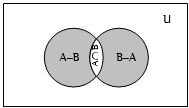
If $A$ and $B$ are two sets then $(A -B) \cup (B -A) \cup (A \cap B)$ is equal to
  • $A \cup B$
  • B
    $A \cap B$
  • C
    $A$
  • D
    $B'$

Answer

Correct option: A.
$A \cup B$
a
(a) From Venn-Euler's diagram,

$\therefore (A - B)\, \cup (B - A) \cup (A \cap B) = A \cup B$.
Need a full question paper?

Generate a complete, print-ready paper with questions like this in minutes — across 16+ boards, with answer keys.

Start Generating Free

Similar questions

Consider $f(x)=\left\{\begin{matrix}
tan^{-1}(\frac{\alpha x+\beta}{\gamma})\ \ \ x\in(0,\frac{1}{2}) and   \\0  \ \ \  \ \ \ \ x=\frac{1}{2}
 and \\ ln(\beta x^2 +2) \ \ \ \ \ \ x\in(\frac{1}{2},1) 
and\end{matrix}\right.$  . If $f(x)$ continuous and derivable in its domain then the value of $\alpha + \beta + \gamma$ is-
The differential equation of all circles in the first quadrant which touch the coordinate axes is of order
A man walks a distance of $3$ units from the origin towards the north-east $\left(\mathrm{N} 45^{\circ} \mathrm{E}\right)$ direction. From there, he walks a distance of $4$ units towards the north-west $\left(\mathrm{N} 45^{\circ} \mathrm{W}\right)$ direction to reach a point $\mathrm{P}$. Then the position of $\mathrm{P}$ in the Argand plane is
Let $N$ be the set of natural numbers and two functions $f$ and $g$ be defined as $f$, $g : N \to N$ such that $f\left( n \right) = \left\{ \begin{gathered}
  \frac{{n + 1}}{2}\,\,\,\,\,\,\,\,\,\,\,{\text{if n is odd}} \hfill \\
  \frac{n}{2}\,\,\,\,\,\,\,\,\,\,\,\,\,\,\,\,\,{\text{if n is even}} \hfill \\ 
\end{gathered}  \right.$ and $g(n) = n - (-1)^n$. Then $\text{fog}$ is
Let a common tangent to the curves $y^2=4 x$ and $(x-4)^2+y^2=16$ touch the curves at the points $P$ and $Q$. Then $( PQ )^2$ is equal to $..........$.
Let $\vec a = \hat i + \hat j + \hat k,\,\,\,\vec c = \hat j - \hat k$ and a vector $\vec b$ be such that $\vec a \times \vec b = \,\vec c$ and $\vec a\, \cdot \,\vec b = \,3.$ Then $\left| {\vec b} \right|$ equals?
If $f(x)$ is a quadratic expression such that $f(1) + f (2)\, = 0$ , and $-1$ is a root of $f(x)\, = 0$, then the other root of $f(x)\, = 0$ is
If a circle passing through the point $(-1, 0)$ touches $y-$ axis at $(0, 2)$, then the length of the chord of the circle along the $x-$ axis is
The values of $\lambda$ and $\mu$ for which the system of linear equations

$x+y+z=2$

$x+2 y+3 z=5$

$x+3 y+\lambda z=\mu$

has infinitely many solutions are, respectively

Given that for each $a \in(0,1)$

$\lim _{n \rightarrow 0^{+}} \int_n^{1-n} t^{-3}(1-t)^{a-1} d t$

exists. Let this limit be $g(a)$. In addition, it is given that the function $g(a)$ is differentiable on $(0,1)$.

$1.$ The value of $g\left(\frac{1}{2}\right)$ is

$(A)$ $\pi$ $(B)$ $2 \pi$ $(C)$ $\frac{\pi}{2}$ $(D)$ $\frac{\pi}{4}$

$2.$ The value of $g ^{\prime}\left(\frac{1}{2}\right)$ is

$(A)$ $\frac{\pi}{2}$ $(B)$ $\pi$ $(C)$ $-\frac{\pi}{2}$ $(D)$ $0$

Give the answer question $1$ and $2.$