MCQ
If $a + b + c = 0,\,\,\left| {\vec a} \right| = 3,\,\left| {\vec b} \right| = 5$ and $\left| {\vec c} \right| = 7,$ then the angle between $\vec a$ and $\vec b$ is
  • $\frac {\pi }{3}$
  • B
    $\frac {\pi }{4}$
  • C
    $\frac {\pi }{6}$
  • D
    $\frac {\pi }{2}$

Answer

Correct option: A.
$\frac {\pi }{3}$
a
$\text { Let } a+b+c=0 \Rightarrow(a+b)=-c$

$\Rightarrow \quad(a+b)^{2}=c^{2}$

$\Rightarrow a^{2}+b^{2}+2 a b=c^{2}$

$\Rightarrow 9+25+2.3 .5 \cos \theta=49$

$(\because|\vec{a}|=3,|\vec{b}|=5 \text { and }|\vec{c}|=7)$

$\therefore \cos \theta=\frac{1}{2} \Rightarrow \theta=\frac{\pi}{3}$

Need a full question paper?

Generate a complete, print-ready paper with questions like this in minutes — across 16+ boards, with answer keys.
Start Generating Free

Similar questions

Let $\text{f(x)}=\begin{vmatrix}\cos\text{x}&\text{x}&1\\2\sin\text{x}&\text{x}&2\text{x}\\\sin\text{x}&\text{x}&\text{x}\end{vmatrix},$ then $\lim_\limits{\text{x}\rightarrow0}\frac{\text{f(x)}}{\text{x}^2}$ is equal to:
  1. 0
  2. -1
  3. 2
  4. 3
If P(A) = 0.4, P(B) = 0.8 and P(B|A) = 0.6 then $\text{P}(\text{A}\cup\text{B})=$
  1. 0.24
  2. 0.3
  3. 0.48
  4. 0.96
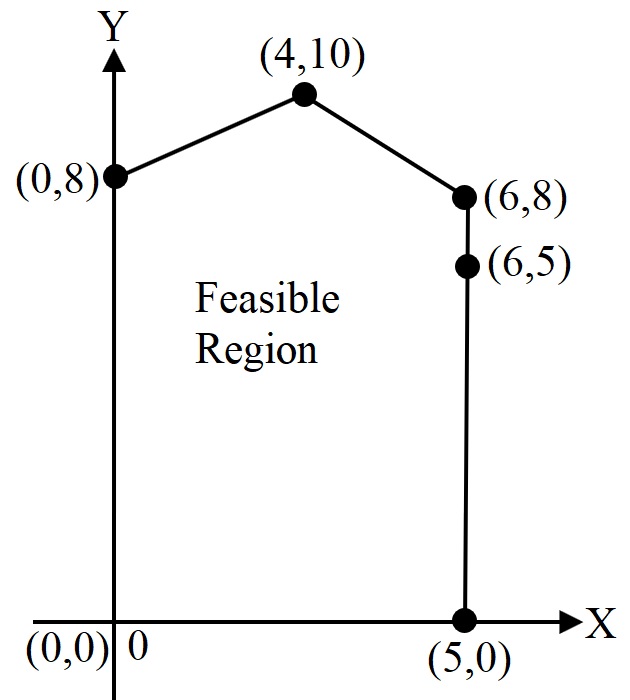
The feasible region for a LPP is shown shaded in the figure. Let Z = 3x - 4y be the objective function. Minimum of Z occurs at.

  1. (0, 0)
  2. (0, 8)
  3. (5, 0)
  4. (4, 10)
Let $( a , b ) \subset(0,2 \pi)$ be the largest interval for which $\sin ^{-1}(\sin \theta)-\cos ^{-1}(\sin \theta) > 0, \theta \in(0,2 \pi)$ holds. If $\alpha x^2+\beta x+\sin ^{-1}\left(x^2-6 x+10\right)+\cos ^{-1}$ $\left(x^2-6 x+10\right)=0$ and $\alpha-\beta=b-a$, then $\alpha$ is equal to:
Find the maximum value of $f(x)=\sin (\sin x)$ for all $x \in R$.
Let $I_n=\int_0^{\pi / 2} x^n \cos x d x$, where $n$ is a non-negative integer. Then, $\sum \limits_{n=2}^{\infty}\left(\frac{I_n}{n !}+\frac{I_n-2}{(n-2) !}\right)$ equals
If $|\vec{\text{a}}|=\big|\vec{\text{b}}\big|,$ then $\big(\vec{\text{a}}+\vec{\text{b}}\big).\big(\vec{\text{a}}-\vec{\text{b}}\big)=$
  1. Positive
  2. Negetive
  3. 0
  4. None of these
Choose the correct answer from the given four options.
If $\sin^{-1}\Big(\frac{2\text{a}}{1+\text{a}^2}\Big)+\cos^{-1}\Big(\frac{1-\text{a}^2}{1+\text{a}^2}\Big)=\tan^{-1}\Big(\frac{2\text{x}}{1-\text{x}^2}\Big),$ where $\text{a},\ \text{x}\in[0,1]$ then the value of x is:
  1. $0$
  2. $\frac{\text{a}}{2}$
  3. $\text{a}$
  4. $\frac{2\text{a}}{1-\text{a}^2}$
Let $y=y(x)$ be the solution of the differential equation

$\left(x^2+4\right)^2 d y+\left(2 x^3 y+8 x y-2\right) d x=0 \text {. If } y(0)=0 \text {, }$ then $y(2)$ is equal to

If $\int {x{e^{2x}}\,\,dx} $ is equal to ${e^{2x}}f(x) + C$ where  $C$ is constant of integration, then $ f(x)$  is