MCQ
If $A + B + C = {180^o},$ then $\sum {\tan \frac{A}{2}\tan \frac{B}{2} = } $
  • A
    $0$
  • $1$
  • C
    $2$
  • D
    $3$

Answer

Correct option: B.
$1$
b
(b) We have $A + B + C = {180^o}$

==> $\frac{A}{2} = \frac{\pi }{2} - \left( {\frac{{B + C}}{2}} \right)$  

$\therefore$ $\cot \frac{A}{2} = \tan \left( {\frac{B}{2} + \frac{C}{2}} \right)$ 

==> $\frac{1}{{\tan \frac{A}{2}}} = \frac{{\tan \frac{B}{2} + \tan \frac{C}{2}}}{{1 - \tan \frac{B}{2}\tan \frac{C}{2}}}$

==> $1 - \tan \frac{B}{2}\tan \frac{C}{2} $

$= \tan \frac{A}{2}.\tan \frac{B}{2} + \tan \frac{A}{2}.\tan \frac{C}{2}$

$\tan \frac{A}{2}.\tan \frac{B}{2} + \tan \frac{B}{2}\tan \frac{C}{2} + \tan \frac{A}{2}\tan \frac{C}{2} = 1$ 

$i.e.$, $\sum {\tan \frac{A}{2}\tan \frac{B}{2} = 1} $.

Need a full question paper?

Generate a complete, print-ready paper with questions like this in minutes — across 16+ boards, with answer keys.
Start Generating Free

Similar questions

If the solution for $\theta $ of $\cos p\theta + \cos q\theta = 0,\;p > 0,\;q > 0$ are in $A.P.$, then the numerically smallest common difference of $A.P.$ is
The fractional part of a real number $x$ is $x-[x]$ where $[x]$ is the greatest integer less than or equal to $x$. Let $F_1$ and $F_2$ be the fractional parts of $(44-\sqrt{2017})^{2017}$ and $(44+\sqrt{2017})^{2017}$, respectively. Then, $F_1+F_2$ lies bet ween the numbers
If the coefficients of $x$ and $x^{2}$ in the expansion of $(1+x)^{p}(1-x)^{q}, p, q \leq 15$, are $-3$ and $-5$ respectively, then the coefficient of $x ^{3}$ is equal to $............$
If $\frac{{\tan 3\theta - 1}}{{\tan 3\theta + 1}} = \sqrt 3 $, then the general value of $\theta $ is
Suppose the sequence $a_1, a_2, a_3, \ldots$ is a n arithmetic progression of distinct numbers such that the sequence $a_1, a_2, a_4, a_8, \ldots$ is a geometric progression. The common ratio of the geometric progression is
Choose the correct answer. $L$ is the foot of the perpendicular drawn from a point $P(3, 4, 5)$ on the $xy-$plane. The coordinates of point $L$ are:
Let tangents drawn from point $C(0,-b)$ to hyperbola $\frac{{{x^2}}}{{{a^2}}} - \frac{{{y^2}}}{{{b^2}}} = 1$ touches hyperbola at points $A$ and $B.$ If $\Delta ABC$ is a right angled triangle, then $\frac{a^2}{b^2}$ is equal to -
The number of $4 -$digit numbers which are neither multiple of $7$ nor multiple of $3$ is ..... .
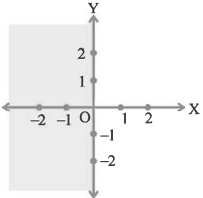
The inequality to represent the coloured region in figure is....
$\cos35^\circ+\cos85^\circ+\cos155^\circ=$