Question
If $a, b, c$ and $d$ are in proportion, prove that: $ a b c d\left[\left(\frac{1}{a^2}+\frac{1}{b^2}+\frac{1}{c^2}+\frac{1}{d^2}\right]= a ^2+ b ^2+ c ^2+ d ^2\right. $

Answer


$\begin{aligned} & \because a _{,} b , c _r d \text { are in proportion } \\ & \frac{a}{b}=\frac{c}{d}= k (\text { say) } \\ & a = bk , c = dk . \\ & \text { L.H.S. }=a b c d\left(\frac{1}{a^2}+\frac{1}{b^2}+\frac{1}{c^2}+\frac{1}{d^2}\right) \\ & =b k \cdot b \cdot d k \cdot d\left[\frac{1}{b^2 k^2}+\frac{1}{b^2}+\frac{1}{d^2 k^2}+\frac{1}{d^2}\right] \\ & =k^2 b^2 d^2\left[\frac{d^2+d^2 k^2+b^2+b^2 k^2}{b^2 d^2 k^2}\right] \\ & = d ^2\left(1+ k ^2\right)+ b ^2(1+ k 2) \\ & =\left(1+ k ^2\right)\left( b ^2+ d ^2\right) \\ & \text { R.H.S. }= a ^2+ b ^2+ c + d ^2 \\ & = b ^2 k ^2+ b ^2+ d ^2 k ^2+ d ^2 \\ & = b ^2\left( k ^2+1\right)+ d ^2\left( k ^2+1\right) \\ & =\left( k ^2+1\right)\left( b ^2+ d ^2\right) \\ & \therefore \text { L.H.S. }=\text { R.H.S. }\end{aligned}$

Need a full question paper?

Generate a complete, print-ready paper with questions like this in minutes — across 16+ boards, with answer keys.

Start Generating Free

Similar questions

Marks obtained by 200 students in an examination are given below:
Marks 0 - 10 10 - 20 20 - 30 30 - 40 40 - 50 50 - 60 60 - 70 70 - 80 80 - 90 90 - 100
Frequency 5 11 10 20 28 37 40 29 14 6
Draw an ogive for the given distribution taking 2 cm = 10 marks on one axis and 2 cm = 20 students on the other axis. Using the graph, determine:
(i) The median marks
(ii) The number of students who failed if minimum marks required to pass is 40.
(iii) If scoring 85 and more marks is considered as grade one, find the number of students who secured grade one in the examination.
M is the mid-point of the line segment joining the points A$(-3, 7)$ and B$(9, -1).$ Find the coordinates of point M. Further, if R$(2, 2)$ divides the line segment joining M and the origin in the ratio $p : q,$ find the ratio $p : q$
Two isosceles triangles have equal vertical angles. Show that the triangles are similar.If the ratio between the areas of these two triangles is $16 : 25,$ find the ratio between their corresponding altitudes.
A circus tent is cylindrical to a height of 5 m and conical above it. If its diameter is 42 m and slant height of the cone is 53 m, calculate the total area of the canvas required.
The weight of 60 boys are given in the following distribution table

 
Weight (kg) 37 38 39 40 41
No.of boys 10 14 18 12 6

Find
(1) median
(2) lower quartile
(3)Upper quartile
(4) Interquatile range
Construct a triangle ABC in which AB = 5 cm, BC = 6.8 cm and median AD = 4.4 cm. Draw incircle of this triangle.
If $(x – 2)$ is a factor of the expression $2x^3 + ax^2 + bx – 14$ and when the expression is divided by $(x – 3),$ it leaves a remainder $52,$ find the values of $a$ and $b$
If sum of first 6 terms of an AP is 36 and that of the first 16 terms is 256, find the sum of first 10 terms.
Using only ruler and compasses, construct a triangle ABC 1 with AB = 5 cm, BC = 3.5 cm and AC= 4 cm. Mark a point P, which is equidistant from AB, BC and also from Band C. Measure the length of PB.
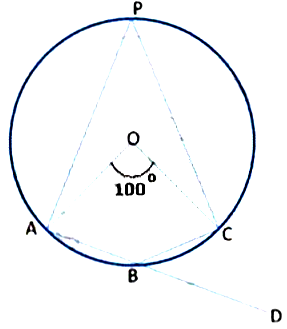
In following fig., O is the centre of the circle. Find ∠ CBD.