Question
If $a, b, c$ and $d$ are in proportion, prove that:
$
\frac{a^2+a b+b^2}{a^2-a b+b^2}=\frac{c^2+c d+d^2}{c^2-c d+d^2}
$

Answer


$\begin{aligned} & \because a , b , c , d \text { are in proportion } \\ & \frac{a}{b}=\frac{c}{d}= k \text { (say) } \\ & a = bk , c = dk . \\ & \text { L.H.S. }=\frac{a^2+a b+b^2}{a^2-a b+b^2} \\ & =\frac{b^2 k^2+b k \cdot b+b^2}{b^2 k^2-b k \cdot b+b^2} \\ & =\frac{b^2\left(k^2+k+1\right)}{b^2\left(k^2-k+1\right)} \\ & =\frac{k^2+k+1}{k^2-k+1} \\ & \text { R.H.S. }=\frac{c^2+c d+d^2}{c^2-c d+d^2} \\ & =\frac{d^2 k^2+d k d+d^2}{d^2 k^2-d k \cdot d+d^2} \\ & =\frac{d^2\left(k^2+k+1\right)}{d^2\left(k^2-k+1\right)} \\ & =\frac{k^2+k+1}{k^2-k+1} \\ & \therefore \text { L.H.S. = R.H.S. }\end{aligned}$

Need a full question paper?

Generate a complete, print-ready paper with questions like this in minutes — across 16+ boards, with answer keys.
Start Generating Free

Similar questions

Ms. Chitra opened a saving bank account with SBI on 05.04.2007 with a cheque deposit of Rs 11,000/.Subsequently, she took out Rs 3,200/- on 12.05.2007; deposited a cheque of Rs. 8,800/- on 03.06.2007 and paid Rs 2,000/- by cheque on 18.06.2007.
Make the entries in her passbook.
The line segment joining $P (-4,5)$ and $Q (3,2)$ intersects the $y$-axis at R . PM and QN are perpendiculars from P and Q on $x$-axis. Find:
(a) the ratio $PR : RQ$
(b) the coordinates of R
(c) the area of the quadrilateral PMNQ.
A card is drawn at random from a deck of cards. Find the probability of getting:
(a) a red king
(b) a queen or a jack
A lady holds 1800, Rs 100 shares of a company that pays 15% dividend annually. Calculate her annual dividend. If she had bought these shares at 40% premium, what is the return she gets as per cent on her investment? Give your answer to the nearest integer.
Two tangents are drawn to a circle from an external point P. touching the circle at the points A and B. A third tangent intersects segment PA in C and segment PB in D and touches the circle at Q. if PA = 20 units, find the perimeter of Δ PCD.
Solve the following equation by factorization$\frac{x-3}{x+3}+\frac{x+3}{x-3}=2 \frac{1}{2}$
Prove that the circle drawn with any side of a rhombus as a diameter, passes through the point of intersection of its diagonals.
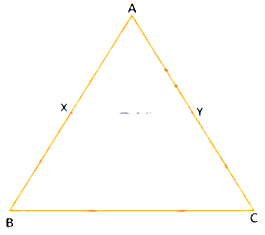
In the given figure, $AX : XB = 3: 5$

(i) the length of BC, if the length of XY is 18 cm.
(ii) the ratio between the areas of trapezium XBCY and triangle ABC.
Find the value of $'a\ ’$ for which the following points $A (a, 3), B (2, 1)$ and $C (5, a)$ are collinear. Hence find the equation of the line.
A wire is in the form of a circle of radius $42 \ cm$. It is bent into a square. Determine the side of the square and compare the area of the regions enclosed in two cases.