MCQ
If $a$, $b$, $c$, $d$, $e$, $f$ are in $G.P$., then the value of $\left| {\begin{array}{*{20}{c}}
  {{a^2}}&{{d^2}}&x \\ 
  {{b^2}}&{{e^2}}&y \\ 
  {{c^2}}&{{f^2}}&z 
\end{array}} \right|$ depends on
  • A
    $x, y$
  • B
    $x, z$
  • C
    $y, z$
  • None

Answer

Correct option: D.
None
d
$\mathrm{b}=\mathrm{ar}, \mathrm{c}=\mathrm{ar}^{2}, \mathrm{d}=\mathrm{ar}^{3}, \mathrm{e}=\mathrm{ar}^{4}, \mathrm{f}=\mathrm{ar}^{6}$

$\therefore\left|\begin{array}{ccc}{a^{2}} & {a^{2} r^{6}} & {x} \\ {a^{2} r^{2}} & {a^{2} r^{3}} & {y} \\ {a^{2} r^{6}} & {a^{2} r^{10}} & {z}\end{array}\right|$

$=a^{2} \times a^{2} r^{6}\left|\begin{array}{ccc}{1} & {1} & {x} \\ {r^{2}} & {r^{2}} & {y} \\ {r^{4}} & {r^{4}} & {z}\end{array}\right|=0$

Need a full question paper?

Generate a complete, print-ready paper with questions like this in minutes — across 16+ boards, with answer keys.

Start Generating Free

Similar questions

If A is square matrix such that, $A ^2= A$ then $(1+ A )^2-3 A=$ ___________.
The probability distribution of a discrete random variable X is given below:

$\text{X}:$

$2$

$3$

$4$

$5$

$\text{P}(\text{X}):$

$\frac{5}{\text{k}}$

$\frac{7}{\text{k}}$

$\frac{9}{\text{k}}$

$\frac{11}{\text{k}}$

The value of k is:

  1. 8
  2. 16
  3. 32
  4. 48
Let $A^{-1}=\left[\begin{array}{lll}1 & 2017 & 2 \\ 1 & 2017 & 4 \\ 1 & 2018 & 8\end{array}\right]$ Then, $|2 A|-\left|2 A^{-1}\right|$ is equal to
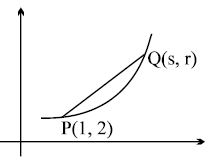
The graph of function $f$ contains the point $P (1, 2)$ and $Q(s, r)$. The equation of the secant line through $P$ and $Q$ is $y = \left( {\frac{{{s^2} + 2s - 3}}{{s - 1}}} \right)$ $x - 1 - s$. The value of $f ‘ (1)$, is
The function $\sin x - \cos x$ is increasing in the interval
If six cards are selected at random (without replacement) from a standard deck of 52 cards, what is the probability that there will be no pairs? (two cards of same denomination)
Given that $f (x)$ is continuously differentiable on $a \le x \le b$ where $a < b, f (a) < 0$ and $f (b) > 0$, which of the following are always true ?

$(i)$ $f (x)$ is bounded on $a \le x \le b.$

$(ii)$ The equation $f (x) = 0$ has at least one solution in $a < x < b.$

$(iii)$ The maximum and minimum values of $f (x)$ on $a \le x \le b$ occur at points where $f ' (c) = 0$.

$(iv)$ There is at least one point $c$ with $a < c < b$ where $f ' (c) > 0$.

$(v)$ There is at least one point $d$ with $a < d < b$ where $f ' (c) < 0.$

For $\text{x, }\in\text{ R},\text{f}(\text{x})=\mid\log2-\sin\text{x}\mid$ and g(x) = f(f(x)) then:
  1. $\text{g}'(0)=\cos (\log2)$
  2. $\text{g}'(0)=-\cos (\log2)$
  3. $\text{g }\text{is diffrerentible at x = 0 and }\text{g}'(0)=-\sin(\log2)$
  4. $\text{g }\text{is diffrerentible at x = 0 }$
The function $f$ satisfies the functional equation $3f(x) + 2f\left( {\frac{{x + 59}}{{x - 1}}} \right) = 10x + 30$ for all real $x \ne 1$. The value of $f(7)$ is
If the feasible region for a solution of linear inequations is bounded, it is called as: