Question
If $a: b=c: d$, then prove that $\frac{a^2+c^2}{b^2+d^2}=\frac{a c}{b c}$

Answer

$\frac{ a }{ b }=\frac{ c }{ d } \Rightarrow a =\frac{ bc }{ d }$
To prove,
$\frac{ a ^2+ c ^2}{ b ^2+ d ^2}=\frac{ ac }{ bd }$
LHS
$\frac{a^2+c^2}{b^2+d^2} $
$=\frac{\left(\frac{b c}{d}\right)^2+c^2}{b^2+d^2} $
$=\frac{\frac{b^2 c^2}{d^2}+c^2}{b^2+d^2} $
$=\frac{c^2\left(b^2+d^2\right)}{d^2\left(b^2+d^2\right)} $
$=\frac{c^2}{d^2}$
$\text { RHS } $
$ \frac{ ac }{ bd }$
$=\frac{\frac{ bc }{ d c}}{ bd } $
$ =\frac{ bc ^2}{ bd ^2} $
$ =\frac{ c ^2}{ d ^2} $
$ \text { LHS }=\text { RHS }$

Need a full question paper?

Generate a complete, print-ready paper with questions like this in minutes — across 16+ boards, with answer keys.

Start Generating Free

Similar questions

In $MBC, DE$ is drawn parallel to $BC.$ If $AD: DB=2:3, DE =6\ cm$ and $AE =3.6\ cm,$ find $BC$ and $AC.$
A sum of money placed at compound interest compounded annually amounts to $Rs.26,460$ in $2$ years and to $Rs.29,172.15$ in $4$ years. Calculate the rate of interest and the sum.

Use ruler and compass only for the following question. All construction lines and arcs must be clearly shown.

(i) Construct a ΔABC in which BC = 6.5 cm, ∠ABC = 60°, AB = 5 cm.

(ii) Construct the locus of points at a distance of 3.5 cm from A.

(iii.) Construct the locus of points equidistant from AC and BC.

(iv)Mark 2 points X and Y which are at a distance of 3.5 cm from A and also equidistant from AC and BC. Measure XY.
$ABCD$ is a square . If the coordinates of $A$ and $C$ are $(5 , 4)$ and $(-1 , 6) ;$ find the coordinates of $B$ and $D.$
Akanksha invested 15%, 25% and 35% of her savings in buying shares of 'Infosys', 'Wipro' and 'Reliance' which declared dividends of 16%, 18% and 20% respectively. If her total income from dividends is Rs 52,125, find her savings and the amount invested in each company.
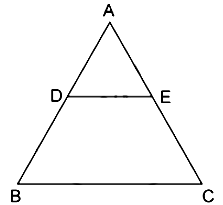
In the given figure, Δ ABC ~ Δ ADE. If AE: EC = 4 : 7 and DE = 6.6 cm, find BC. If 'x' be the length of the perpendicular from A to DE, find the length of perpendicular from A to BC in terms of 'x'.
From a solid cylinder whose height is $16\ cm$ and radius is $12\ cm,$ a conical cavity of height $8\ cm$ and of base radius $6\ cm$ is hollowed out. Find the volume and total surface area of the remaining solid.
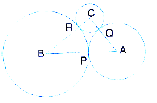
ABC is a triangle with AB = 10 cm, BC = 8 cm and AC = 6 cm (not drawn to scale). Three circle are drawn touching each other with the vertices as their centres. Find the radii of the three circles
Draw line segments OA = 4.5 cm, OB = 3.2 cm such that ∠ AOB = 45°. Construct a circle touching OA at A and passing through B.
The angle of elevation of a tower from a point $200 \mathrm{~m}$ from its base is $\theta$, when $\tan \theta=\frac{2}{5}$. The angle of elevation of this tower from a point $120 \mathrm{~m}$ from its base is $\Phi$. Calculate the height of tower and the value of $\Phi$.