MCQ
If a charged particle at rest experiences no electromagnetic force:
- AThe electric field must be zero.
- BThe magnetic field must be zero.
- CThe electric field may or may not be zero.
- DThe magnetic field may or may not be zero.
Explanation:
Force on charged particle in an electric eld, $\text{F} = \text{qE} \ ...(1)$
Force on charged particle in a magnetic eld $\text{F} = \text{q} (\text{v}\times\text{b}) = \text{qvB} \sin\theta \ ...(2) $
Where boldface letter represent vector nature of that quantity, q is charge of the particle, v is the velocity of the particle( if any), and $\theta$ is the angle between velocity and magnetic eld.
From (1), FE = 0 only when either q = 0 or E = 0.
Let q ≠ 0, and F ≠ 0, then we must have E ≠ 0
From (2), if q ≠ 0, v ≠ 0 and B ≠ 0 even then FB can be 'zero' because of θ = 0° or 180°
Generate a complete, print-ready paper with questions like this in minutes — across 16+ boards, with answer keys.
In a single slit diffraction experiment first minimum for red light (660 nm) coincides with first maximum of some other wavelength l'. The value of l' is
|
(a) 4400 Å |
(b) 6600 Å |
(c) 2000 Å |
(d) 3500 Å |
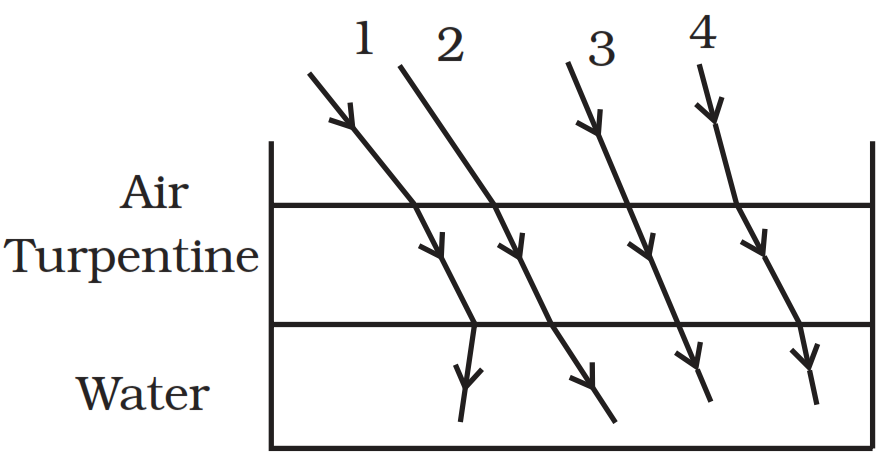
The optical density of turpentine is higher than that of water while its mass density is lower. Fig. shows a layer of turpentine floating over water in a container. For which one of the four rays incident on turpentine in Fig, the path shown is correct?
In case of linearly polarized light, the magnitude of the electric field vector :
|
(a) Does not change with time |
|
(b) Varies periodically with time |
|
(c) Increases and decreases linearly with time |
|
(d) Is parallel to the direction of propagation |
The given figure represents a material which is

|
(a) Paramagnetic |
(b) Diamagnetic |
(c) Ferromagnetic |
(d) None of these |
The energy equivalent of 1 kilogram of matter is about
|
(a) |
(b) 1 J |
(c) |
(d) |
Monochromatic light of frequency 5  Hz travelling in vacuum enters a medium of refractive index 1.5. Its wavelength in the medium is
|
(a) 4000 Å |
(b) 5000 Å |
(c) 6000 Å |
(d) 5500 Å |


