Question
If a constant potential difference is applied across a bulb, the current slightly decreases as time passes and then becomes constant. Explain.

Answer

As current passes through wire of bulb it heats up and thus the resistance of wire (element) increase as its metal so current decreases as resistance increases after element is heated well the resistance stops increasing thus current stops decreases.

Need a full question paper?

Generate a complete, print-ready paper with questions like this in minutes — across 16+ boards, with answer keys.
Start Generating Free

Similar questions

A small disc is set rolling with a speed v on the horizontal part of the track of the previous problem from right to left. To what height will it climb up the curved part?
A student records the following data for the magnitudes $(B)$ of the magnetic field at axial points at different distances $x$ from the centre of a circular coil of radius a carrying a current $I$. Verify $($for any two$)$ that these observations are in good agreement with the expected theoretical variation of $B$ with $x$.
Image
$x \rightarrow$ $x = 0$ $x - a$ $x = 2 a$ $x = 3a$
$y \rightarrow$ $B _0$ $0.25 \sqrt{2} B_0$ $0.039 \sqrt{5} B_0$ $0.010 \sqrt{10} B_0$

 
What is the effect of heating of a conductor on the drift velocity of free electrons?
If a constant potential difference is applied across a bulb, the current slightly decreases as time passes and then becomes constant. Explain.
Find the average force needed to accelerate a car weighing 500kg from rest to 72km/h in a distance of 25m.
Find the increase in energy of a condenser of capacity 6 µF on changing potential difference from 10 V to 20 V.
Figure. shows a cylindrical tube of cross$-$sectional area $A$ fitted with two frictionless pistons. The pistons are connected to each other by a metallic wire. Initially, the temperature of the gas is $T_0$ and its pressure is $P,$ which equals the atmospheric pressure. $(a)$ What is the tension in the wire? $(b)$ What will be the tension if the temperature is increased to $2T_0$?
Find the height over the earth's surface at which the weight of a body becomes half of its value at the surface.
In order to have a current in a long wire, it should be connected to a battery or some such device. Can we obtain the magnetic due to a straight, long wire by using Ampere's law without mentioning this other part of the circuit?
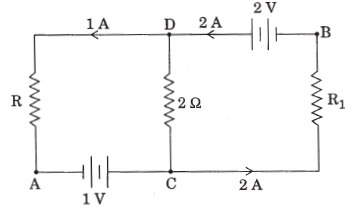
In the given circuit, assuming point $A$ to be at zero potential, use Kirchhoff's rules to determine the potential at point $B.$