Question
If a constant potential difference is applied across a bulb, the current slightly decreases as time passes and then becomes constant. Explain.

Answer

As current passes through wire of bulb it heats up and thus the resistance of wire (element) increase as its metal so current decreases as resistance increases after element is heated well the resistance stops increasing thus current stops decreases.

Need a full question paper?

Generate a complete, print-ready paper with questions like this in minutes — across 16+ boards, with answer keys.
Start Generating Free

Similar questions

Which of the following functions of time represent (a) simple harmonic, (b) periodic but not simple harmonic, and (c) non-periodic motion? Give period for each case of periodic motion ($\omega$ is any positive constant): $3\cos\Big(\frac{\pi}{4}-2\omega\text{t}\Big)$
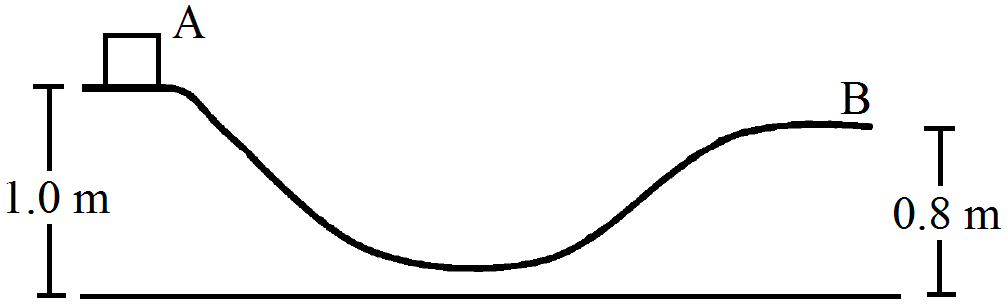
A block of mass 1kg is placed at the point A of a rough track shown in figure. If slightly pushed towards right, it stops at the point B of the track. Calculate the work done by the frictional force on the block during its transit from A to B.
Suppose you have three resistors of $20\Omega,50\Omega$ and $100\Omega.$ What minimum and maximum resistance can you obtain from these resistors?
A tuning fork of frequency $440Hz$ is attached to a long string of linear mass density $0.01\ kg/m$ kept under a tension of $49N$. The fork produces transverse waves of amplitude $0.50\ mm$ on the string.
  1. Find the wave speed and the wavelength of the waves.
  2. Find the maximum speed and acceleration of a particle of the string.
  3. At what average rate is the tuning fork transmitting energy to the string?
Name four fundamental forces in nature.
If the absolute temperature of a black- body is double what would be its effect on emitted energy?
Two bodies of different masses m, and m, are dropped from two different heights 'a' and 'b'. What is the ratio of time taken by the two to drop through these distances?
Equal masses of monoatomic and diatomic gases are supplied heat at the same temperature, pressure and volume. If same amount of heat is supplied to both the gases, which of them will undergo greater temperature rise?
Is a 'single isolated force' possible in nature?
Is friction a necessary evil? Justify.