Question
If a constant potential difference is applied across a bulb, the current slightly decreases as time passes and then becomes constant. Explain.

Answer

As current passes through wire of bulb it heats up and thus the resistance of wire (element) increase as its metal so current decreases as resistance increases after element is heated well the resistance stops increasing thus current stops decreases.

Need a full question paper?

Generate a complete, print-ready paper with questions like this in minutes — across 16+ boards, with answer keys.
Start Generating Free

Similar questions

Write the principle of MODEM in brief.
A pivoted aluminium bar falls much more slowly through a small region containing a magnetic field than a similar bar of an insulating material. Explain.
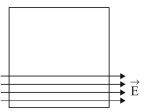
A square surface of side L meter is kept in the plane of the paper. A uniform elecrtric field $\overrightarrow{ E }$ is also present in the plane of the paper and it is limited to the lower half of the page as shown in the figure. What will be the electric flux bound to the surface?Image
A metallic rod of 'L' length is rotated with angular frequency of '$\omega$' with one end hinged at the centre and the other end at the circumference of a circular metallic ring of radius L, about an axis passing through the centre and perpendicular to the plane of the ring. A constant and uniform magnetic field B parallel to the axis is present everywhere. Deduce the expression for the emf between the centre and the metallic ring.
Light falls from glass $(\mu=1.5)$ to air. Find the angle of incidence for which the angle of deviation is 90°.
Write conclusion of Oersted's experiment.
A converging lens and a diverging lens of the same focal length are placed coaxially in contact with each other. Find the focal length and power of the combination.
An $\alpha$-particle and a proton are accelerated through the same potential difference. Find the ratio of their de Broglie wavelength.
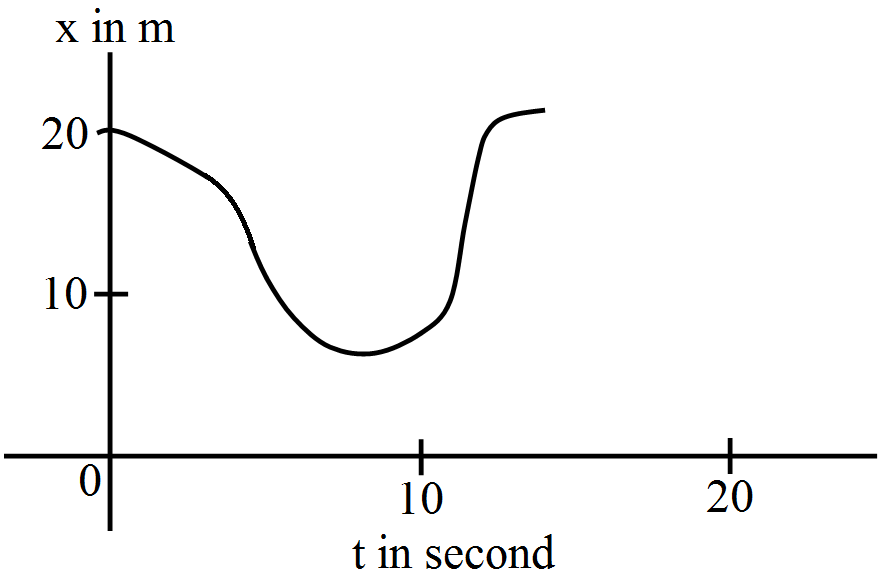
Figure shows x-t graph of a particle. Find the time t such that the average velocity of the particle during the period 0 to t is zero.