Question
If a LC circuit is considered analogous to a harmonically oscillating spring block system, which energy of the LC circuit would be analogous to potential energy and which one analogous to kinetic energy?
Answer


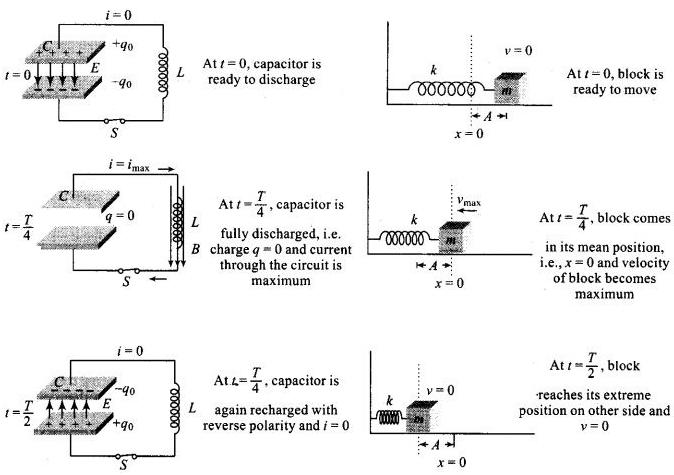
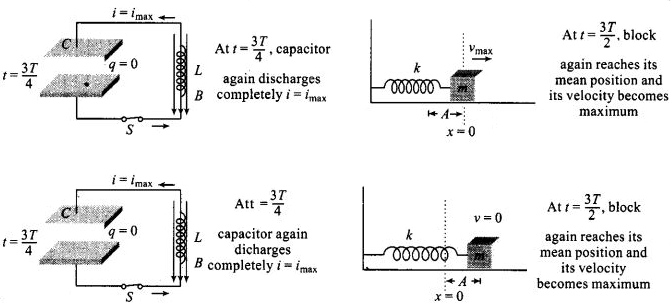
When a charged capacitor C having an initial charge $q_0$ is discharged through an inductance L, the charge and current in the circuit start oscillating simple harmonically. If the resistance of the circuit is zero, no energy is dissipated as heat. We also assume an idealized situation in which energy is not radiated away from the circuit. The total energy associated with the circuit is constant.
The oscillation of the LC circuit are an electromagnetic analog to the mechanical oscillation of a block-spring system.
The total energy of the system remains conserved.
$\frac{1}{2}\text{CV}^2+\frac{1}{2}\text{LI}^2=\text{Constant}=\frac{1}{2}\text{CV}^2_0=\frac{1}{2}\text{LI}^2_0$

Mass spring systerm
v/s
LC circuit
Displacement (x)
 
Charge (q)
Velocity (v)
 
Current (i)
Acceleration (a)
 
Rate of change of current $\Big(\frac{\text{di}}{\text{dt}}\Big)$
Mass (m) [Inertia]
 
Inductance (L) [Inertia of electricity]
Momentum (p = mv)
 
Magnetic flux $(\phi=\text{Li})$
Retarding force $\Big(-\text{m}\frac{\text{dv}}{\text{dt}}\Big)$
 
Self induced emf $\Big(-\text{L}\frac{\text{di}}{\text{dt}}\Big)$
Equation of free oscillations:
$\frac{\text{d}^2\text{x}}{\text{dt}^2}=-\omega^2\text{x};$
where $\omega=\sqrt{\frac{\text{K}}{\text{m}}}$
 
Equation of free oscillations:
$\frac{\text{d}^2\text{q}}{\text{dt}^2}=-\Big(\frac{1}{\text{LC}}\Big).\text{q};\text{where }\omega^2=\frac{1}{\text{LC}}$
$\Rightarrow\ \omega=\frac{1}{\sqrt{\text{LC}}}$
Force constant K
 
Capacitance C
Kinetic energy $=\frac{1}{2}\text{mv}^2$
 
Magnetic energy $=\frac{1}{2}\text{Li}^2$
Elastic potential energy $=\frac{1}{2}\text{Kx}^2$
 
Elecrical potential energy $=\frac{1}{2}\frac{\text{q}^2}{\text{C}}$
If we consider an L-C circuit analogous to a harmonically oscillating spring block system. The electrostatic energy $\frac{1}{2}\text{CV}^2$ is analogous to potential energy and energy associated with moving charges (current) that is magnetic energy $\Big(\frac{1}{2}\text{LI}^2\Big)$ is analogous to kinetic energy.

Need a full question paper?

Generate a complete, print-ready paper with questions like this in minutes — across 16+ boards, with answer keys.
Start Generating Free

Similar questions

Explain the variation of conductivity with temperature for:
  1. A metallic conductor.
  2. Ionic conductors.
  3. Semiconductors.
A sphercial capacitor is made of two conducting spherical shells of radii a and b. The space between the shells is filled with a dielectric of dielectric constant K up to a radius c as shown in figure. Calculate the capacitance.
Figure shows a plane mirror M placed at a distance of 10cm from a concave lens L. A point object is placed at a distance of 60cm from the lens. The image formed due to refraction by the lens and reflection by the mirror is 30cm behind the mirror. What is the focal length of this lens?
A rectangular loop of sides 20cm and 10cm carries a current of 5.0A. A uniform magnetic field of magnitude 0.20T exists parallel to the longer side of the loop.
  1. What is the force acting on the loop?
  2. What is the torque acting on the loop?
An electron of kinetic energy 100eV circulates in a path of radius 10cm in a magnetic field. Find the magnetic field and the number of revolutions per second made by the electron.
A body of weight $w_1$ is suspended from the ceiling of a room through a chain of weight $w_2$. The ceiling pulls the chain by a force:
An electron falls through a distance of $1.5 \ cm$ in a uniform electric field of magnitude $2.0 \times 10^4 N C ^{-1} \ [$Fig. $1.10(a)]$. The direction of the field is reversed keeping its magnitude unchanged and a proton falls through the same distance $[$Fig. $1.10(b)]$. Compute the time of fall in each case. Contrast the situation with that of 'free fall under gravity'.
Image
A block slides down an inclined surface of inclination 30° with the horizontal. Starting from rest it covers 8m in the first two seconds. Find the coefficient of kinetic friction between the two.
The teachers of Geeta’s school took the students on a study trip to a power generating station, located nearly 200km away from the city. The teacher explained that electrical energy is transmitted over such a long distance to their city, in the form of alternating current (ac) raised to a high voltage. At the receiving end in the city, the voltage is reduced to operate the devices. As a result, the power loss is reduced. Geeta listened to the teacher and asked questions about how the ac is converted to a higher or lower voltage.
  1. Name the device used to change the alternating voltage to a higher or lower value. State one cause for power dissipation in this device.
  2. Explain with an example, how power loss is reduced if the energy is transmitted over long distances as an alternating current rather than a direct current.
  3. Write two values each shown by the teachers and Geeta.
In a Young's double slit experiment, the separation between the slits = 2.0mm, the wavelength of the light = 600nm and the distance of the screen from the slits = 2.0m. If the intensity at the centre of the central maximum is $0.20W/ m^2$, what will be the intensity at a point 0.5cm away from this centre along the width of the fringes?