Question
If a line is drawn parallel to the base of an isosceles triangle to intersect its equal sides, prove that the quadrilateral so formed is cyclic.
Answer

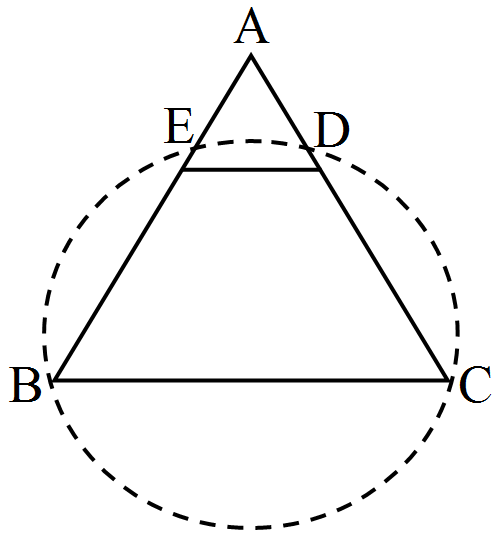
Given: $\triangle\text{ABC}$ is an isosceles triangle such that $AB = AC$ and also $DE || SC.$
To prove: Quadrilateral $BCDE$ is a cyclic quadrilateral.
Construction: Draw a circle passes through the points $B, C, D$ and $E.$​​​​​​​

Proof: In $\triangle\text{ABC},\ \ \text{AB}=\text{AC} [$equal sides of an isosceles triangle$]$
$\Rightarrow\angle\text{ACB}=\angle\text{ABC}\ \ ...(\text{i})$ [angles opposite to the equal sides are equal]
Since, $DE || BC$
$\Rightarrow\angle\text{ADE}=\angle\text{ACB} [$corresponding angles$] ....(ii)$
On adding both sides by $\angle\text{EDC}$ in Eq. $(ii)$, we get,
​​​​​​​$\angle\text{ADE}+\angle\text{EDC}=\angle\text{ACB}+\angle\text{EDC}$
$\Rightarrow180^\circ=\angle\text{ACB}+\angle\text{EDC}$ [$\angle\text{ADE}$ and $\angle\text{EDC}$ from linear pair aniom]
​​​​​​​$\Rightarrow\angle\text{EDC}+\angle\text{ABC}=180^\circ$ [from Eq. (i)]
Hence, $BCDE$ is cyclic quadrilateral, because sum opposite angles is $180^\circ .$

Need a full question paper?

Generate a complete, print-ready paper with questions like this in minutes — across 16+ boards, with answer keys.
Start Generating Free

Similar questions

The height of a right circular cylinder is $10.5\ m$. Three times the sum of the areas of its two circular faces is twice the area of the curved surface. Find the volume of the cylinder.
Two cubes, each of volume $512\ cm^3$ are joined end to end. Find the surface area of the resulting cuboid.
The perimeter of a triangle is $50\ cm$. One side of the triangle is $4\ cm$ longer than the smallest side and the third side is $6\ cm$ less than twice the smallest side. Find the area of the triangle.
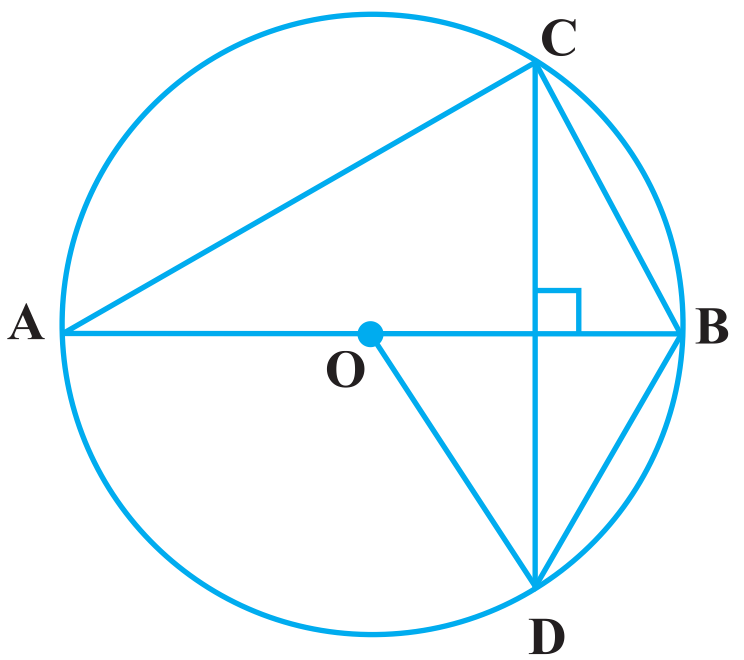
In Fig. $O$ is the centre of the circle, $BD = OD$ and $\text{CD}\bot\text{AB}.$ Find $\angle\text{CAB}.$
Prove that the perpendicular bisectors of the sides of a cyclic quadrilateral are concurrent.
The following table shows the daily production of $T.V.$ sets in an industry for $7$ days of a week:
Day
Mon
Tue
Wed
Thurs
Fri
Sat
Sun
Number of T.V. Sets
$300$
$400$
$150$
$250$
$100$
$350$
$200$
Represent the above information by a pictograph.
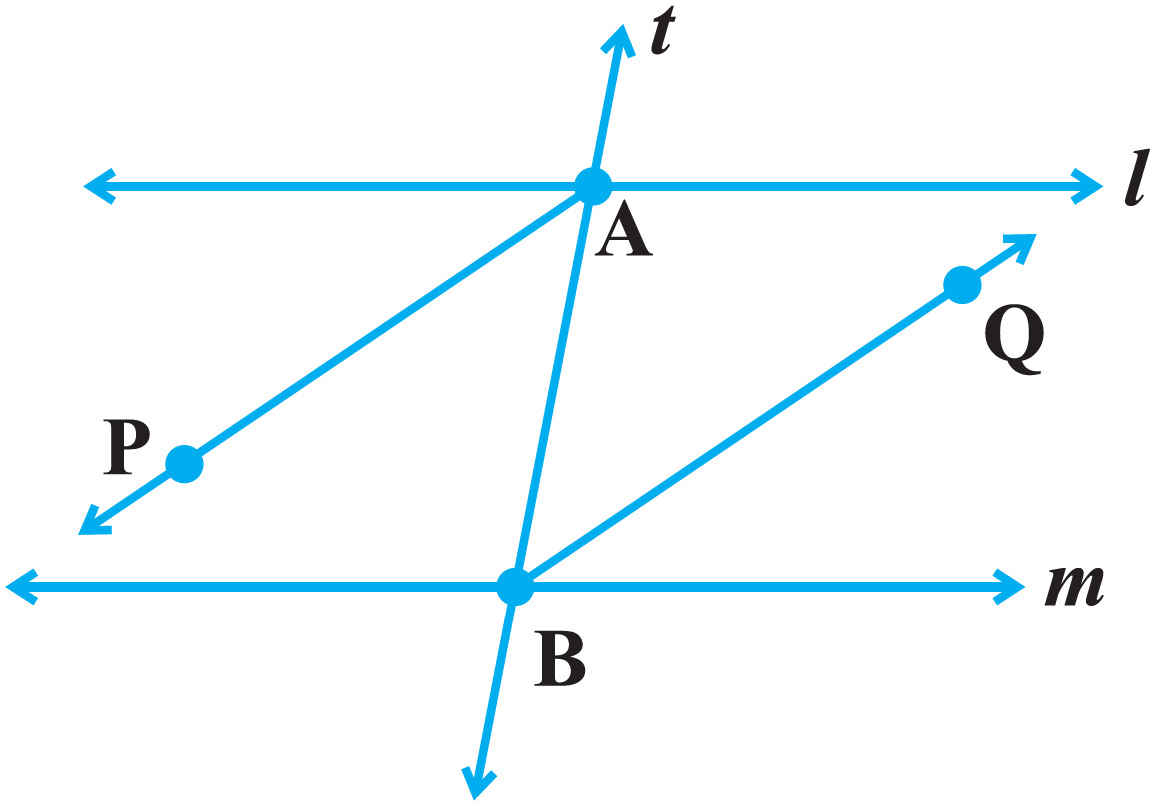
$AP$ and $BQ$ are the bisectors of the two alternate interior angles formed by the intersection of a transversal t with parallel lines l and m (Fig.). Show that $\text{AP}||\text{BQ}.$
If $\text{x}=\frac{5-\sqrt{21}}{2},$ find the value of $\text{x}+\frac{1}{\text{x}}.$
$E$ and $F$ are respectively the mid-points of the non-parallel sides $AD$ and $BC$ of a trapezium $ABCD.$ Prove that $EF || AB$ and$\text{EF}=\frac{1}{2}(\text{AB}=\text{CD})$
$[$Hint: Join $BE$ and produce it to meet $CD$ produced at $G.]$