MCQ
If a matrix $A=\left[\begin{array}{lll}1 & 2 & 3\end{array}\right]$, then the matrix $A A^{\prime}$ (where $A^{\prime}$ is the transpose of $A$ ) is
  • A
    14
  • B
    $\left[\begin{array}{lll}1 & 0 & 0 \\ 0 & 2 & 0 \\ 0 & 0 & 3\end{array}\right]$
  • C
    $\left[\begin{array}{lll}1 & 2 & 3 \\ 2 & 3 & 1 \\ 3 & 1 & 2\end{array}\right]$
  • D
    [14]

Answer

$(d): A=\left[\begin{array}{lll}1 & 2 & 3\end{array}\right]$
$A^{\prime}=\left[\begin{array}{l}1 \\ 2 \\ 3\end{array}\right]$
So, $A A^{\prime}=\left[\begin{array}{lll}1 & 2 & 3\end{array}\right]\left[\begin{array}{l}1 \\ 2 \\ 3\end{array}\right]=[1+4+9]=[14]$

Need a full question paper?

Generate a complete, print-ready paper with questions like this in minutes — across 16+ boards, with answer keys.

Start Generating Free

Similar questions

The value of $'a'$ $(a>0)$ for which the area bounded by the curves $y = \frac{x}{6} + \frac{1}{{{x^2}}},\,y = 0,\,x = a$ and $x = 2a$ has the least value, is
Let $A$ is a symmetric and $ \,B$ is a skew symmetric matrix, such that  $A - B = \left[ {\begin{array}{*{20}{c}}
  1&2 \\ 
  3&4 
\end{array}} \right]$, then $|A|$ is
Let $A = \left[ {\begin{array}{*{20}{c}}1&0&0\\5&2&0\\{ - 1}&6&1\end{array}} \right]$, then the adjoint of $ A $ is
The maximum number of equivalence relations on the set A = {1, 2, 3} is:
  1. 1
  2. 2
  3. 3
  4. 5
$\int {\frac{{{e^{{{\tan }^{ - 1}}x}}}}{{(1 + {x^2})}}\,\,\left[ {{{\left( {{{\sec }^{ - 1}}\,\sqrt {1 + {x^2}} } \right)}^2}\,\, + \,\,{{\cos }^{ - 1}}\,\left( {\frac{{1 - {x^2}}}{{1 + {x^2}}}} \right)} \right]} \,\,\,dx$ $(x > 0)$
Let $S=\left\{E, E_{2} \ldots . E_{8}\right\}$ be a sample space of random experiment such that $P\left(E_{n}\right)=\frac{n}{36}$ for every $n =1,2 \ldots .$. Then the number of elements in the set $\left\{ A \subset S : P ( A ) \geq \frac{4}{5}\right\}$ is
The area bounded by the lines |x| + |y| = 1 is:
  1. 1 sq. unit
  2. 2 sq. units
  3. $2\sqrt{2}\text{ sq}.\text{units}$
  4. 4 sq. units
${\tan ^{ - 1}}\frac{{{c_1}x - y}}{{{c_1}y + x}} + {\tan ^{ - 1}}\frac{{{c_2} - {c_1}}}{{1 + {c_2}{c_1}}} + $ ${\tan ^{ - 1}}\frac{{{c_3} - {c_2}}}{{1 + {c_3}{c_2}}} + ... + {\tan ^{ - 1}}\frac{1}{{{c_n}}} = $
The solution of differential equation $(x^2 -xy)dy = (xy + y^2)dx$ is
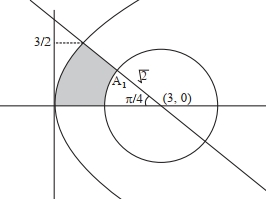
If the area bounded by the curve $2 y^2=3 x$, lines $x+y=3, y=0$ and outside the circle $(x-3)^2+y^2=2$ is $A$, then $4(\pi+4 A )$ is equal to $.........$.