MCQ
If $a \ne 6,b,c$ satisfy $\left| {\,\begin{array}{*{20}{c}}a&{2b}&{2c}\\3&b&c\\4&a&b\end{array}\,} \right| = 0,$then $abc = $
  • A
    $a + b + c$
  • B
    $0$
  • ${b^3}$
  • D
    $ab + bc$

Answer

Correct option: C.
${b^3}$
c
(c) $\left| {\,\begin{array}{*{20}{c}}
  a&{2b}&{2c} \\ 
  3&b&c \\ 
  4&a&b 
\end{array}\,} \right| = 0 =  > \left| {\,\begin{array}{*{20}{c}}
  {a - 6}&0&0 \\ 
  3&b&c \\ 
  4&a&b 
\end{array}\,} \right| = 0$ $[R_1 → R_1 -2R_2]$

==> $(a - 6)({b^2} - ac) = 0 \Rightarrow {b^2} - ac = 0$  $a \ne 6$

$\therefore $ $ac = {b^2} \Rightarrow abc = {b^3}.$

Need a full question paper?

Generate a complete, print-ready paper with questions like this in minutes — across 16+ boards, with answer keys.
Start Generating Free

Similar questions

Let M be the set of all 2 × 2 matrices with entries from the set R of real numbers. Then, the function f : M→ R defined by f(A) = |A| for every A ∈ M, is:
For any three vectors $\vec{\text{a}},\vec{\text{b}},\vec{\text{c}}$ the expression $\big(\vec{\text{a}}-\vec{\text{b}}\big).\big\{\big(\vec{\text{b}}-\vec{\text{c}}\big)\times\big(\vec{\text{c}}-\vec{\text{a}}\big)\big\}$ equals:
The first derivative of the function $\left[ {{{\cos }^{ - 1}}\left( {\sin \sqrt {{{1 + x} \over 2}} } \right) + {x^x}} \right]$ with respect to $x$ at  $x = 1$  is
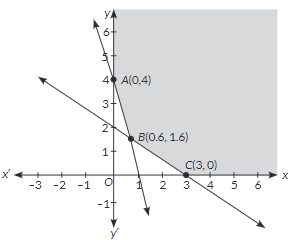
The corner points of the shaded unbounded feasible region of an LPP are $(0,4),(0.6,1.6)$ and $(3,0)$ as shown in the figure. The minimum value of the objective function $Z=4 x+6 y$ occurs at
Image
If $c$ is any arbitrary constant, then the general solution of the differential equation $ydx - xdy = xy\,dx$ is given by
Three persons, A, B and C fine a target in turn starting with A. Their probability of hitting the target are 0.4, 0.2 and 0.2, respectively. The probability of two hits is
If points $\text{A}(60\hat{\text{i}}+3\hat{\text{j}}),\ \text{B}(40\hat{\text{i}}-8\hat{\text{j}})$ and $\text{C}(\text{a}\hat{\text{i}}+52\hat{\text{j}})$ are collinear, then a is equal to,
Choose the correct answers from the given four options : If $\text{f(x)}=\begin{cases}\text{mx}+1,&\text{if x}\leq\frac{\pi}{2}\\\sin\text{x}+\text{n},&\text{if x}>\frac{\pi}{2}\end{cases},$ is continuous at $\text{x}=\frac{\pi}{2},$ then :
If ${x^2} + {y^2} = t - \frac{1}{t},{x^4} + {y^4} = {t^2} + \frac{1}{{{t^2}}}$ then $\frac{{dy}}{{dx}}$ equals
If $\int_0^\pi {x\,f({{\cos }^2}x + {{\tan }^4}x)\,dx} $ $ = k\int_0^{\pi /2} {f({{\cos }^2}x + {{\tan }^4}x)\,dx,} $ then the value of $k$ is