MCQ
If a particle moves in a circle describing equal angles in equal times, its velocity vector
  • A
    Remains constant
  • B
    Changes in magnitude
  • Changes in direction
  • D
    Changes both in magnitude and direction

Answer

Correct option: C.
Changes in direction
c
(c)It is always directed in a direction of tangent to circle.

Need a full question paper?

Generate a complete, print-ready paper with questions like this in minutes — across 16+ boards, with answer keys.

Start Generating Free

Similar questions

Two bodies of mass $4 g$ and $25 g$ are moving with equal kinetic energies. The ratio of magnitude of their linear momentum is :
A unif orm non-deformable cylinder of mass $m$ and radius $R$ is rolling without slipping on a horizontal rough surface. The force of friction is
A charged shell of radius $R$ carries a total charge $Q$. Given $\Phi$ as the flux of electric field through a closed cylindrical surface of height $h$, radius $r$ and with its center same as that of the shell. Here, center of the cylinder is a point on the axis of the cylinder which is equidistant from its top and bottom surfaces. Which of the following option(s) is/are correct ? $\epsilon_0$ is the permittivity of free space]

$(1)$ If $h >2 R$ and $r > R$ then $\Phi=\frac{ Q }{\epsilon_0}$

$(2)$ If $h <\frac{8 R }{5}$ and $r =\frac{3 R }{5}$ then $\Phi=0$

$(3)$ If $h >2 R$ and $r =\frac{4 K }{5}$ then $\Phi=\frac{ Q }{5 \epsilon_0}$

$(4)$ If $h >2 R$ and $r =\frac{3 K }{5}$ then $\Phi=\frac{ Q }{5 \epsilon_0}$
In Fresnel’s biprism experiment, on increasing the prism angle, fringe width will
A charged particle of charge $Q $ is held fixed and another charged particle of mass $m$ and charge $q$ (of the same sign) is released from a distance $r.$ The impulse of the force exerted by the external agent on the fixed charge by the time distance between $Q$ and $q$ becomes $2r$ is
The work function for tungsten and sodium are $4.5 eV$ and $2.3 eV$ respectively. If the threshold wavelength $\lambda $ for sodium is $5460{Å}$, the value of $\lambda $ for tungsten is ............ $\mathop {\rm{A}}\limits^o $
A transverse wave propagating on the string can be described by the equation $y=2 \sin (10 x+300 t)$. where $x$ and $y$ are in metres and $t$ in second. If the vibrating string has linear density of $0.6 \times 10^{-3} \,g / cm$, then the tension in the string is .............. $N$
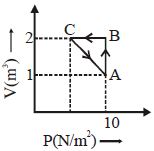
An ideal gas is taken through the cycle $A \to B \to C \to A,$ as shown in the figure. What is the change in internal energy ...... $J$.
The displacement due to a wave moving in the positive $x-$direction is given by $y = \frac{1}{{(1 + {x^2})}}$ at time $t = 0$ and by $y = \frac{1}{{[1 + {{(x - 1)}^2}]}}$ at $t = 2$ seconds, where $x$ and $y$ are in metres. The velocity of the wave in $m/s$ is
The de Broglie wavelength of an electron having kinetic energy $E$ is $\lambda$. If the kinetic energy of electron becomes $\frac{E}{4}$, then its de-Broglie wavelength will be :