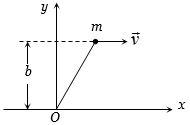
- A$mvb\,\hat k$
- ✓$ - mvb\, \,\hat k$
- C$mvb\,\hat i$
- D$mv\,\hat i$
$\overrightarrow L = \left| {\,\begin{array}{*{20}{c}}
{\hat i\,\,}&{\hat j\,\,}&{\hat k} \\
{x\,\,}&{y\,\,}&z \\
{{p_x}}&{\,\,{p_y}\,\,}&{{p_z}}
\end{array}\,} \right|$
As motion is in x-y plane ($z = 0 $ and ${P_z} = 0$), so $\overrightarrow {L\,} = \overrightarrow {k\,} (x{p_y} - y{p_x})$
Here $x = vt, y = b, $${p_x} = m\,v$ and ${p_y} = 0$
$\therefore \overrightarrow {L\,} = \overrightarrow {k\,} \left[ {vt \times 0 - b\,mv} \right] = - mvb\,\hat k$
Generate a complete, print-ready paper with questions like this in minutes — across 16+ boards, with answer keys.

[$A$] The amount of energy radiated by the body in $1$ second is close to $60$ Joules.
[$B$] If the surrounding temperature reduces by a small amount $\Delta \mathrm{T}_0<<\mathrm{T}_0$, then to maintain the same body temperature the same (living) human being needs to radiate $\Delta \mathrm{W}=4 \sigma \mathrm{T}_0^3 \Delta \mathrm{T}_0$ more energy per unit time.
[$C$] Reducing the exposed surface area of the body ($e.g$ by curling up) allows humans to maintain the same body temperature while reducing the energy lost by radiation.
[$D$] If the body temperature rises significantly then the peak in the spectrum of electromagnetic radiation emitted by the body would shift to longer wavelengths.
Statement $I$ : The contact angle between a solid and a liquid is a property of the material of the solid and liquid as well.
Statement $II$ : The rise of a liquid in a capillary tube does not depend on the inner radius of the tube.
In the light of the above statements, choose the correct answer from the options given below :