Question
If a proton had a radius R and the charge was uniformly distributed, calculate using Bohr theory, the ground state energy of a H-atom when:
  1. R = 0.1Å.
  2. R = 10 Å.

Answer

For a point nucleus in H-atom,
Ground state: mvr = h,
$\frac{\text{mv}^2}{\text{r}_\text{B}}=-\frac{\text{e}^2}{\text{r}^2_\text{B}}.\frac{1}{4\pi\in_0}$
The electrostatic force of attraction between positively charged nucleus and negatively charged electrons (Coulombian force) provides necessary centripetal force of revolution.
$\frac{\text{mv}^2}{\text{r}_\text{B}}=-\frac{\text{e}_2}{\text{r}^2_\text{B}}.\frac{1}{4\pi\in_0}$
By Bohr's postulates in ground state, we have
mvr = h
$\therefore\ \text{m}\frac{\text{h}^2}{\text{m}^2\text{r}^2_\text{B}}=+\Big(\frac{\text{e}^2}{4\pi\in_0}\Big)\frac{1}{\text{r}_\text{B}^2}$
$\therefore\ \frac{\text{h}^2}{\text{m}}.\frac{4\pi\in_0}{\text{e}^2}=\text{r}_\text{B}=0.51\mathring{\text{A}}$
Potential energy
$-\Big(\frac{\text{e}^2}{4\pi\text{r}_0}\Big).\frac{1}{\text{r}_\text{B}}=-27.2\text{ev}; \text{KE}=\frac{\text{mv}^2}{2}=\frac{1}{2}\text{m}.\frac{\text{h}^2}{\text{m}^2\text{r}^2_\text{B}}=\frac{\text{h}}{2\text{mr}^2_\text{B}}=+13.6\text{eV}$
For a spherical nucleus of radius R,
If R < rB, same result.
If R > > rB the electron moves inside the sphere with redius r'B (r'B= new Bohr radius).
Charge inside, $\text{r}_\text{B}^4=\text{e}\Big(\frac{\text{r}^3_\text{B}}{\text{R}^3}\Big)$
$\therefore\ \text{r}'_\text{B}=\frac{\text{h}^2}{\text{m}}\Big(\frac{4\pi\in_0}{\text{e}^2}\Big)\frac{\text{R}^3}{\text{r}_\text{B}'^3}$
$\text{r}_\text{B}'^4=(0.51\mathring{\text{A}}),\text{R}^3\ \ [\text{R}=10\mathring{\text{A}}]$
$=510(\mathring{\text{A}})^4$
$\therefore\ \text{r}'\text{B}\approx(510)^{\frac{1}{4}}\mathring{\text{A}}<\text{R}$
$\text{KE}=\frac{1}{2}\text{mv}^2=\frac{\text{m}}{2}.\frac{\text{h}}{\text{m}^2\text{r}'^2_\text{B}}=\frac{\text{h}}{2\text{m}}.\frac{1}{\text{r}'^2_\text{B}}$
$=\Big(\frac{\text{h}}{2\text{mr}^2_\text{B}}\Big)\Big(\frac{\text{r}^2_\text{B}}{\text{r}'^2_\text{B}}\Big)=(13.6\text{eV})\frac{(0.51)^2}{(510)^\frac{1}{2}}=\frac{3.54}{22.6}=0.16\text{eV}$
$\text{PE}=+\Big(\frac{\text{e}^2}{4\pi\in_0}\Big).\Big(\frac{\text{r}'^2-3\text{R}^2}{2\text{R}^3}\Big)=+\Big(\frac{\text{e}^2}{4\pi\in_0}.\frac{1}{\text{r}_\text{B}}\Big)\bigg(\frac{\text{r}_\text{B}(\text{r}'^2_\text{B}-3\text{R}^2)}{\text{R}^3}\bigg)$
$=+(27.2\text{eV})\bigg[\frac{0.51(\sqrt{510}-300)}{1000}\bigg]$
$=+(27.2\text{eV}),\frac{-141}{1000}=-3.83\text{eV}$

Need a full question paper?

Generate a complete, print-ready paper with questions like this in minutes — across 16+ boards, with answer keys.

Start Generating Free

Similar questions

A 6.5m long ladder rests against a vertical wall reaching a height of 6.0m. A 60kg man stands half way up the ladder.
  1. Find the torque of the force exerted by the man on the ladder about the upper end of the ladder.
  2. Assuming the weight of the ladder to be negligible as compared to the man and assuming the wall to be smooth, find the force exerted by the ground on the ladder.
How many is energy states are present in one mole of sodium vapour? Are they all filled in normal conditions? "How many 3s energy states are present in one mole of sodium vapour? Are they all filled in normal conditions?
The equation of a wave travelling on a string stretched along the X-axis is given by-

$\text{y}=\text{A}\text{e}^{-\Big(\frac{\text{x}}{\text{a}}+\frac{\text{t}}{\text{T}}\Big)^2}.$
  1. Write the dimensions of A, a and T.
  2. Find the wave speed.
  3. In which direction is the wave. travelling?
  4. Where is the maximum of the pulse located at t = T? at t = 2T?
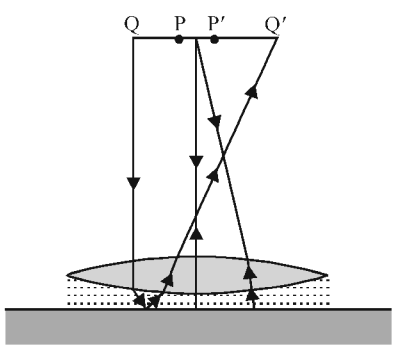
Fig. shows an equiconvex lens (of refractive index 1.50) in contact with a liquid layer on top of a plane mirror. A small needle with its tip on the principal axis is moved along the axis until its inverted image is found at the position of the needle. The distance of the needle from the lens is measured to be 45.0 cm. The liquid is removed and the experiment is repeated. The new distance is measured to be 30.0 cm. What is the refractive index of the liquid?Image
Write advantages and disadvantages of ac over dc and explain applied ac voltage over resistor.
(I) Explain briefly, with the help of a labelled diagram, the basic principle of the working of an a.c. generator. In an a.c. generator, coil of N turns and area A is rotated at an angular velocity ω in a uniform magnetic field B. Derive an expression for the instantaneous value of the emf induced in coil. What is the source of energy generation in this device?
The coil of an electric bulb takes 40 watts to start glowing. If more than 40W is supplied, 60% of the extra power is converted into light and the remaining into heat. The bulb consumes 100W at 220V. Find the percentage drop in the light intensity at a point if the supply voltage changes from 220V to 200V.
A small object is placed at the centre of the bottom of a cylindrical vessel of radius 3cm and height 4cm filled completely with water. Consider the ray leaving the vessel through a corner. Suppose this ray and the ray along the axis of the vessel are used to trace the image. Find the apparent depth of the image and the ratio of real depth to the apparent depth under the assumptions taken. Refractive index of water = 1.33
In semiconductors, thermal collisions are responsible for taking a valence electron to the conduction band. Why does the number of conduction electrons not go on increasing with time as thermal collisions conμnuously take place?
  1. An electron moves along a circle of radius 1m in a perpendicular magnetic field of strength 0.50T. What would be its speed? Is it reasonable?
  2. If a proton moves along a circle of the same radius in the same magnetic field, what would be its speed?