Question
If a real valued function f{x) is finitely derivable at any point of its domain, it is necessarily continuous at that point. But its converse need not be true.
For example, every polynomial, constant function are both continuous as well as differentiable and inverse trigonometric functions are continuous and differentiable in its domains etc.
Based on the above information, answer the following questions.
  1. If $\text{f}(\text{x})=\begin{cases}\text{x},\text{for x}\leq0\\0,\text{for x}>0\end{cases},$ then at x = 0
  1. f(x) is differentiable and continuous.
  2. f(x) is neither continuous nor differentiable.
  3. f(x) is continuous but not differentiable.
  4. None of these.
  1. If $\text{f}(\text{x})=|\text{x}-1|,\text{x }\in\text{ R},$ then at x = 1
  1. f(x) is not continuous.
  2. f(x) is continuous but not differentiable.
  3. f(x) is continuous and differentiable.
  4. None of these.
  1. f(x) = x3 is:
  1. Continuous but not differentiable at x = 3
  2. Continuous but not differentiable at x = 3
  3. Neither continuous nor differentiable at x = 3
  4. None of these.
  1. If $\text{f}(\text{x})=[\sin\text{x}],$ then which of the following is true?
  1. f(x) is continuous and differentiable at x = 0.
  2. f(x) is discontinuous at x = 0.
  3. f(x) is continuous at x = 0 but not differentiable.
  4. f(x) is differentiable but not continuous at $\text{x}=\frac{\pi}{2}.$
  1. If $\text{f}(\text{x})=\sin^{-1}\text{x},-1\leq\text{x}\leq1,$ then:
  1. f(x) is both continuous and differentiable.
  2. f(x) is neither continuous nor differentiable.
  3. f(x) is continuous but not differentiable.
  4. None of these.

Answer

  1. (c) f(x) is continuous but not differentiable.
  1. (b) f(x) is continuous but not differentiable.
  1. (b) Continuous but not differentiable at x = 3
  1. (b) f(x) is discontinuous at x = 0.
  1. (a) f(x) is both continuous and differentiable.

Need a full question paper?

Generate a complete, print-ready paper with questions like this in minutes — across 16+ boards, with answer keys.

Start Generating Free

Similar questions

Consider the mapping f: A → B is defined by f(x) = x - 1 such that f is a bijection.
Based on the above information, answer the following questions.
  1. Domain of f is:
  1. R - {2}
  2. R
  3. R - {1, 2}
  4. R - {0}
  1. Range of f is:
  1. R
  2. R - {2}
  3. R - {0}
  4. R - {1, 2}
  1. If g: R - {2} → R - {1} is defined by g(x) = 2f(x) - 1, then g(x) in terms of x is:
  1. $\frac{\text{x}+2}{\text{x}}$
  2. $\frac{\text{x}+1}{\text{x}-2}$
  3. $\frac{\text{x}-2}{\text{x}}$
  4. $\frac{\text{x}}{\text{x}-2}$
  1. The function g defined above, is:
  1. One-one
  2. Many-one
  3. into
  4. None of these
  1. A function f(x) is said to be one-one iff.
  1. f(x1) = f(x2) ⇒ -x= x2
  2. f(-x1) = f(-x2) ⇒ -x1 = x2
  3. f(x1) = f(x2) ⇒ x1 = x2
  4. None of these
If two vectors are represented by the two sides of a triangle taken in order, then their sum is represented by the third side of the triangle taken in opposite order and this is known as triangle law of vector addition. Based on the above information, answer the following questions.
  1. If $\vec{\text{p}},\vec{\text{q}},\vec{\text{r}}$ are the vectors represented by the sides of a triangle taken in order, then $\vec{\text{q}},+\vec{\text{r}}=$
  1. $\vec{\text{p}}$

  2. $2\vec{\text{p}}$

  3. $-\vec{\text{p}}$

  4. None of these
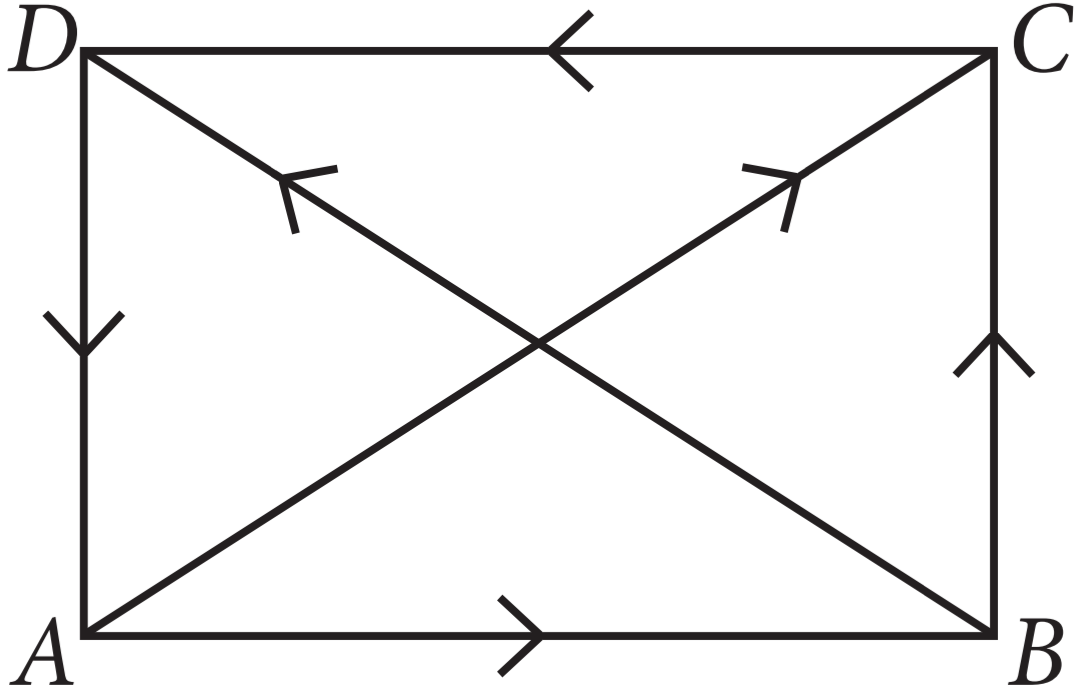
  1. If ABCD is a parallelogram and AC and BD are its diagonals, then $\overline{\text{AC}}+\overline{\text{BD}}=$
  1. $2\overline{\text{DA}}$

  2. $2\overline{\text{AB}}$

  3. $2\overline{\text{BC}}$

  4. $2\overline{\text{BD}}$

  1. If ABCD is a parallelogram, where $\overline{\text{AB}}=2\vec{\text{a}}$ and $\overline{\text{BC}}=2\vec{\text{b}},$ then $\overline{\text{AC}}-\overline{\text{BD}}=$
  1. $3\vec{\text{a}}$

  2. $4\vec{\text{a}}$

  3. $2\vec{\text{b}}$

  4. $4\vec{\text{b}}$

  1. If ABCD is a quadrilateral whose diagonals are $\overline{\text{AC}}$ and $\overline{\text{BD}},$ then $\overline{\text{BA}}+\overline{\text{DC}}=$

  1. $\overline{\text{AC}}+\overline{\text{DB}}$

  2.  $\overline{\text{AC}}+\overline{\text{BD}}$

  3. $\overline{\text{BC}}+\overline{\text{AD}}$

  4. $\overline{\text{BD}}+\overline{\text{CA}}$

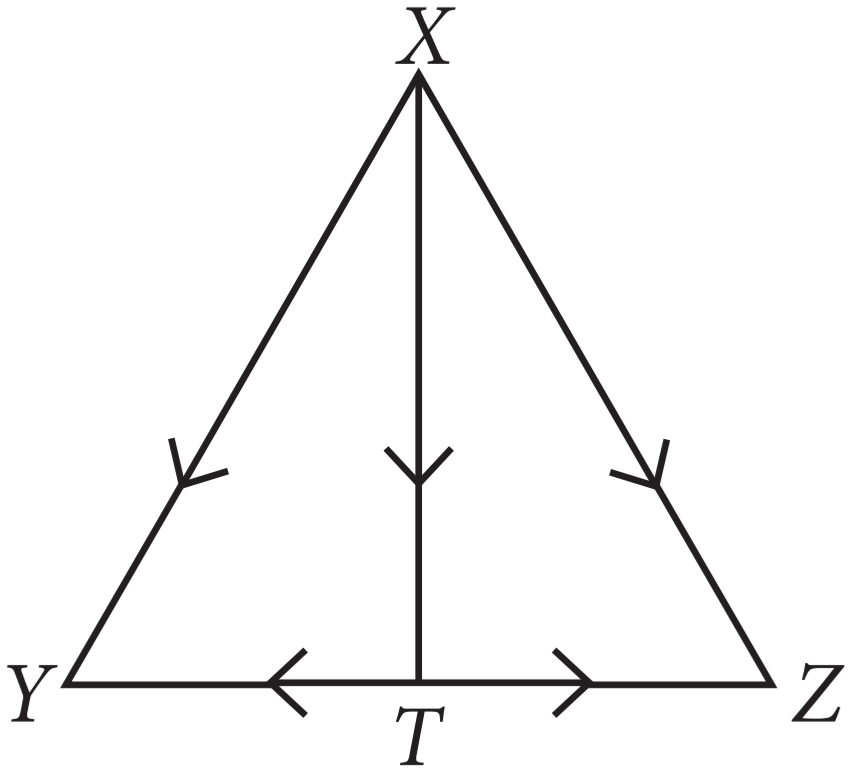
  1. If T is the mid point of side YZ of $\triangle\text{XYZ},$ then $\overline{\text{XY}}+\overline{\text{XZ}}=$

  1. $2\overline{\text{YT}}$

  2. $2\overline{\text{XT}}$

  3. $2\overline{\text{TZ}}$

  4. None of these
In a college hostel accommodating 1000 students, one of the hostellers came in carrying Corona virus, and the hostel was isolated. The rate at which the virus spreads is assumed to be proportional to the product of the number of infected students and remaining students. There are 50 infected students after 4 days.

Based on the above information, answer the following questions.

  1. If n(I) denote the number of students infected by Corona virus at any time I, then maximum value of n(I) is:
  1. 50
  2. 100
  3. 500
  4. 1000
  1. $\frac{\text{dn}}{\text{dt}}$ is proporuona to:
  1. n(1000 - n)
  2. n(100 + n)
  3. n(100 - n)
  4. n(100 + n)
  1. The value of n(4) is:
  1. 1
  2. 50
  3. 100
  4. 1000
  1. The most general solution of differential equation formed in given situation is:
  1. $\frac{1}{1000}\log\Big(\frac{1000-\text{n}}{\text{n}}\Big)=\lambda\text{t}+\text{c}$
  2. $\log\Big(\frac{\text{n}}{100-\text{n}}\Big)=\lambda\text{t}+\text{c}$
  3. $\frac{1}{1000}\log\Big(\frac{\text{n}}{1000-\text{n}}\Big)=\lambda\text{t}+\text{c}$
  4. None of these.
  1. The value of n at any time is given by:
  1. $\text{n(t)}=\frac{1000}{1+999\text{e}^{-0.9906\text{t}}}$
  2. $\text{n(t)}=\frac{1000}{1-999\text{e}^{-0.9906\text{t}}}$
  3. $\text{n(t)}=\frac{100}{1-999\text{e}^{-0.9906\text{t}}}$
  4. $\text{n(t)}=\frac{100}{1+999\text{e}^{-0.9906\text{t}}}$
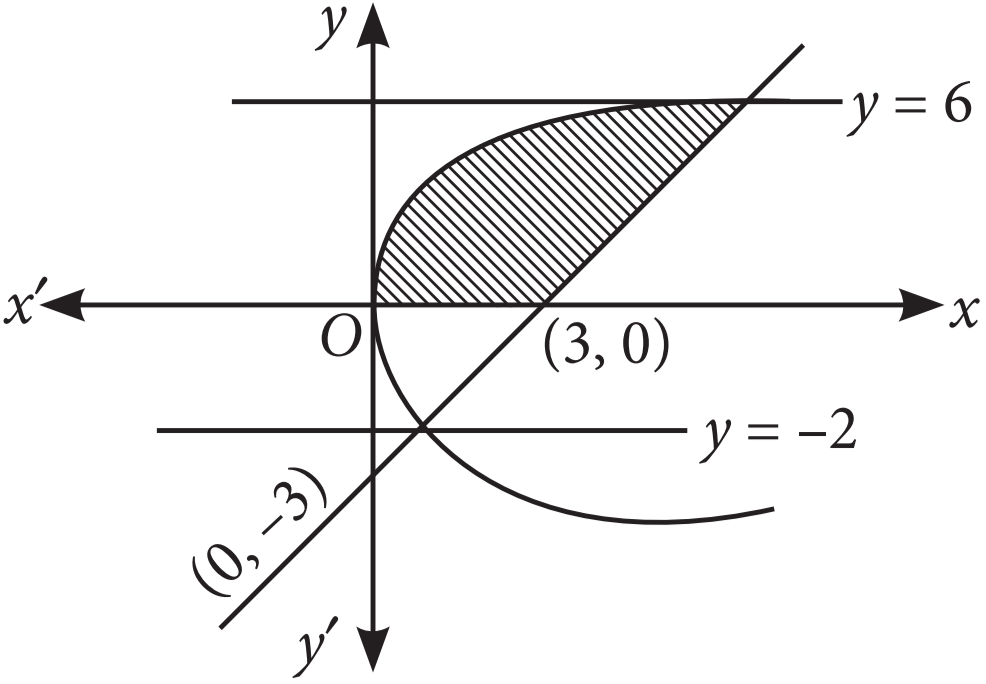
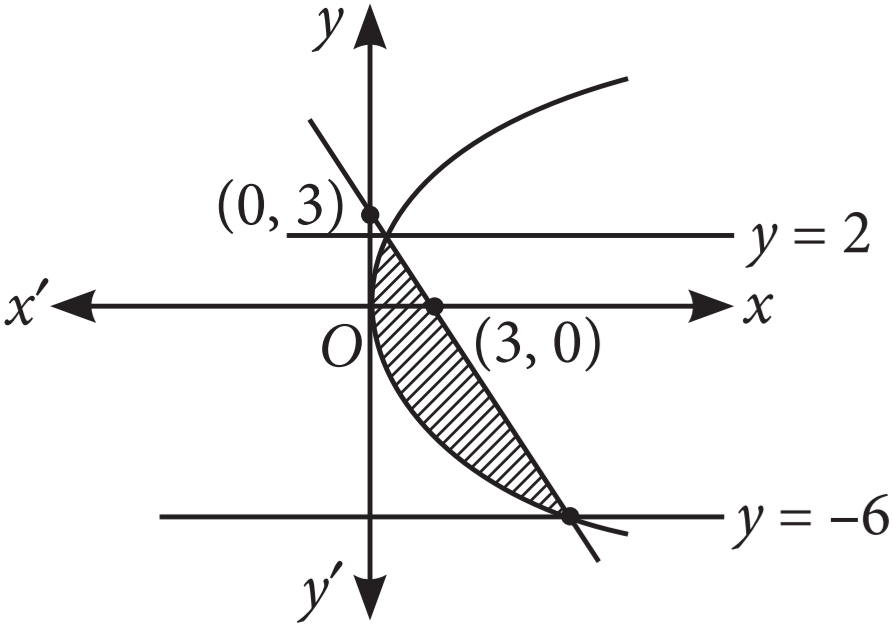
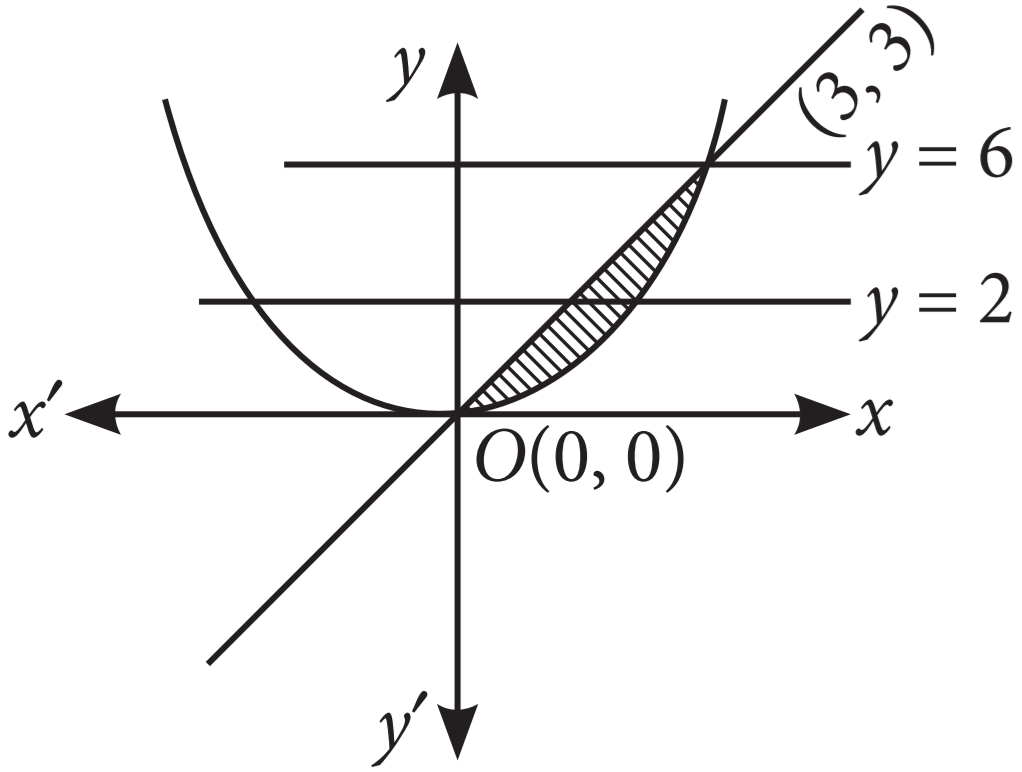
Consider the following equation of curve y2 = 4x and straight line x + y = 3.
Based on the above information, answer the following questions.
  1. The line x + y = 3 cuts the x-axis and y-axis respectively at.
  1. (0, 2), (2, 0)
  2. (3, 3), (0, 0)
  3. (0, 3), (3, 0)
  4. (3, 0), (0, 3)
  1. Point(s) of intersection of two given curves is (are).
  1. (1, -2), (-9, 6)
  2. (2, 1), (-6, 9)
  3. (1, 2), (9, -6)
  4. None of these.
  1. Which of the following shaded portion re present the area bounded by given curves?
    1. None of these
  1. Value of the integral $\int\limits_{-6}^{2}(3-\text{y})\text{ dy}$ is
  1. 10
  2. 20
  3. 30
  4. 40
  1. Value of area bounded by given curves is.
  1. $56\text{ sq.units}$
  2. $\frac{63}{5}\text{ sq. units}$
  3. $\frac{64}{3}\text{ sq. units}$
  4. $31\text{ sq.units}$
Varun and Jsha decided to play with dice to keep themselves busy at home as their schools are closed due to coronavirus pandemic. Varun throw a dice repeatedly until a six is obtained. He denote the number of throws required by X.

Based on the above information, answer the following questions.

  1. The probability that X = 2 equals.
  1. $\frac{1}{6}$

  2. $\frac{5}{6^2}$

  3. $\frac{5}{3^6}$

  4. $\frac{1}{6^3}$
  1. The probability that X = 4 equals.
  1. $\frac{1}{6^4}$

  2. $\frac{1}{6^6}$

  3. $\frac{5^3}{6^4}$

  4. $\frac{5}{6^4}$
  1. The probability that $\text{X}\geq2$ equals.
  1. $\frac{25}{216}$

  2. $\frac{1}{36}$

  3. $\frac{5}{6}$

  4. $\frac{25}{36}$

  1. The value of $\text{P}(\text{X}\geq6)$ is:
  1. $\frac{5^5}{6^5}$

  2. $1-\frac{5^3}{6^5}$

  3. $\frac{5^3\times61}{6^5}$

  4. $\frac{5^3}{6^4}$

  1. The probability that X > 3 equals.
  1. $\frac{36}{25}$

  2. $\frac{5^2}{6^2}$

  3. $\frac{5}{6}$

  4. $\frac{5^3}{6^3}$

In pre-board examination of class XII, commerce stream with Economics and Mathematics of a particular school, 50% of the students failed in Economics, 35% failed in Mathematics and 25% failed in both Economics and Mathematics. A student is selected at random from the class.

Based on the above information, answer the following questions.

  1. The probability that the selected student has failed in Economics, if it is known that he has failed in Mathematics, is:
  1. $\frac{3}{10}$

  2. $\frac{12}{25}$

  3. $\frac{1}{4}$

  4. $\frac{5}{7}$
  1. The probability that the selected student has failed in Mathematics, if it is known that he has failed in Economics, is:
  1. $\frac{22}{25}$

  2. $\frac{12}{25}$

  3. $\frac{1}{2}$

  4. $\frac{3}{25}$
  1. The probability that the selected student has passed in at least one of the two subjects, is:
  1. $\frac{1}{4}$

  2. $\frac{1}{2}$

  3. $\frac{3}{4}$

  4. None of these.

  1. The probability that the selected student has failed in at least one of the two subjects, is:
  1. $\frac{3}{5}$

  2. $\frac{22}{25}$

  3. $\frac{2}{5}$

  4. $\frac{43}{100}$

  1. The probability that the selected student has passed in Mathematics, if it is known that he has failed in Economics, is:
  1. $\frac{2}{5}$

  2. $\frac{3}{4}$

  3. $\frac{1}{3}$

  4. $\frac{1}{2}$ 

Gaurav purchased 5 pens, 3 bags and 1 instrument box and pays ₹ 16. From the same shop, Dheeraj purchased 2 pens, 1 bag and 3 instrument boxes and pays ₹ 19, while Ankur purchased 1 pen, 2 bags and 4 instrument boxes and pays ₹ 25.

Using the concept of matrices and determinants, answer the following questions.
  1. The cost of one pen is:
  1. ₹ 2
  2. ₹ 5
  3. ₹ 1
  4. ₹ 3
  1. What is the cost of one pen and one bag?
  1. ₹ 3
  2. ₹ 5
  3. ₹ 7
  4. ₹ 8
  1. What is the cost of one pen and one instrument box?
  1. ₹ 7
  2. ₹ 6
  3. ₹ 8
  4. ₹ 9
  1. Which of the following is correct?
  1. Determinant is a square matrix.
  2. Determinant is a number associated to a matrix.
  3. Determinant is a number associated to a square matrix.
  4. All of the above.
  1. From the matrix equation AB = AC, it can be concluded that B = C provided:
  1. A is singular.
  2. A is non-singular.
  3. A is symmetric.
  4. A is square.
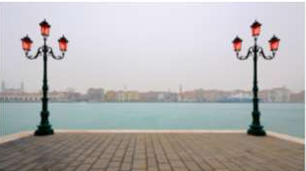
In a street two lamp posts are 600 feet apart. The light intensity at a distance $d$ from the first (stronger) lamp post is $\frac{1000}{d^2}$, the light intensity at distance $d$ from the second (weaker) lamp post is $\frac{125}{d^2}$ (in both cases the light intensity is inversely proportional to the square of the distance to the light source). The combined light intensity is the sum of the two light intensities coming from both lamp posts.

Image

(i) If $\mathrm{l}(\mathrm{x})$ denotes the combined light intensity, then find the value of $\mathrm{x}$ so that $\mathrm{I}(\mathrm{x})$ is minimum.

(ii) Find the darkest spot between the two lights.

(iii) If you are in between the lamp posts, at distance $\mathrm{x}$ feet from the stronger light, then write the combined light intensity coming from both lamp posts as function of $\mathrm{x}$.

OR

Find the minimum combined light intensity?

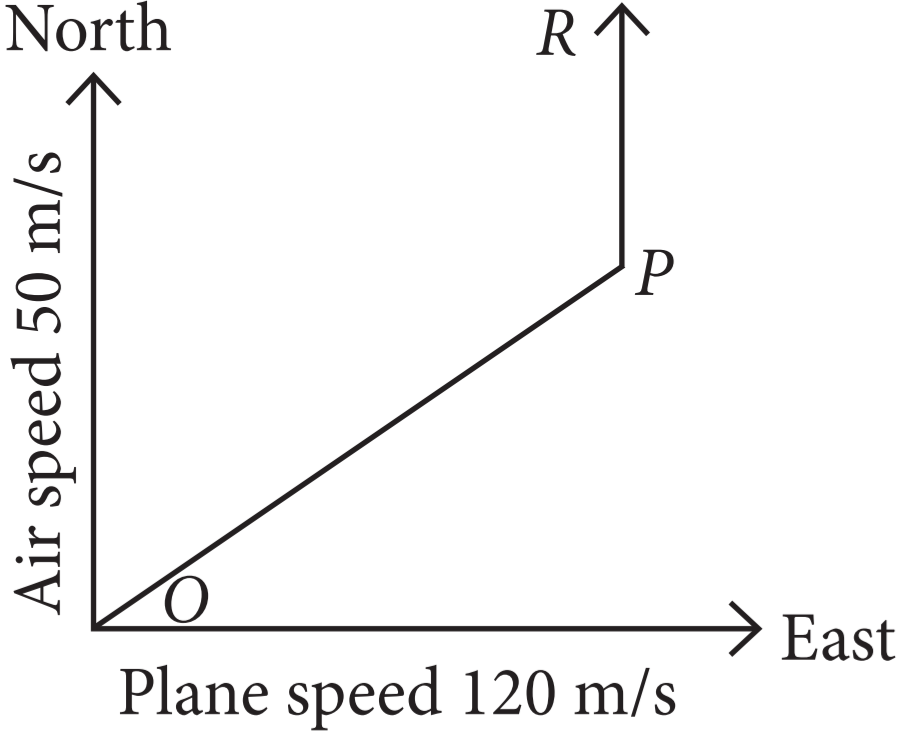
A plane started from airport situated at O with a velocity of 120m/s towards east. Air is blowing at a velocity of 50m/ s towards the north as shown in the figure.
The plane travelled 1hr in OP direction with the resultant velocity. From P to R the plane travelled 1hr keeping velocity of 120m/s and finally landed at R.

Based on the above information, answer the following questions.
  1. What is the resultant velocity from O to P?
  1. 100m/ s
  2. 130m/ s
  3. 126m/ s
  4. 180m/ s
  1. What is the direction of travel of plane from O to P with East?
  1. $\tan^{-1}\Big(\frac{5}{12}\Big)$
  2. $\tan^{-1}\Big(\frac{12}{3}\Big)$
  3. 50
  4. 80
  1. What is the displacement from O to P?
  1. 600km
  2. 468km
  3. 532km
  4. 500km
  1. What is the resultant velocity from P to R?
  1. 120m/ s
  2. 70m/ s
  3. 170m/ s
  4. 200m/ s
  1. What is the displacement from P to R?
  1. 450km
  2. 532km
  3. 610km
  4. 612km
Between students of class XII of two schools A and B basketball match is organised. For which, a team from each school is chosen, say T1 be the team of school A and T2 be the team of school B. These teams have to play two games against each other. It is assumed that the outcomes of the two games are independent. The probability of T1 winning, rawmg an osrng a game against T2 are $\frac{1}{2},\ \frac{3}{10}$ and $\frac{1}{5}$ respecnvely.

Each team gets 2 points for a win, 1 point for a draw and 0 point for a loss in a game.

Let X and Y denote the total points scored by team A and B respectively, after two games.

Based on the above information, answer the following questions.

  1. P(T2 winning a match against T1) is equal to:
  1. $\frac{1}{5}$

  2. $\frac{1}{6}$

  3. $\frac{1}{3}$

  4. None of these
  1. P(T2 drawing a match against T1) is equal to:
  1. $\frac{1}{2}$

  2. $\frac{1}{3}$

  3. $\frac{1}{6}$

  4. $\frac{3}{10}$

  1. P(X > Y) is equal to:
  1. $\frac{1}{4}$

  2. $\frac{5}{12}$

  3. $\frac{1}{20}$

  4. $\frac{11}{20}$

  1. P(X = Y) is equal to:
  1. $\frac{11}{100}$

  2. $\frac{1}{3}$

  3. $\frac{29}{100}$

  4. $\frac{1}{2}$

  1. P(X + Y = 8) is equal to:
  1. $0$

  2. $\frac{5}{12}$

  3. $\frac{13}{36}$

  4. $\frac{7}{12}$