MCQ
If a vector $\vec A$ is parallel to another vector $\vec B$ then the resultant of the vector $\vec A \times \vec B$ will be equal to
  • A
    $A$
  • B
    $\vec A$
  • Zero vector
  • D
    Zero

Answer

Correct option: C.
Zero vector
c
(c) $\overrightarrow A \times \overrightarrow B = AB\sin \theta \,\hat n$

for parallel vectors $\theta = 0^\circ $ or $180^\circ $, $\sin \theta = 0$

$\therefore $ $\overrightarrow A \times \overrightarrow B = \hat 0$


Need a full question paper?

Generate a complete, print-ready paper with questions like this in minutes — across 16+ boards, with answer keys.

Start Generating Free

Similar questions

A hollow sphere is rolling on a plane surface about its axis of symmetry. The ratio of rotational kinetic energy to its total kinetic energy is $\frac{x}{5}$. The value of $x$ is________.
If two metallic plates of equal thicknesses and thermal conductivities ${K_1}$ and ${K_2}$ are put together face to face and a common plate is constructed, then the equivalent thermal conductivity of this plate will be
Diatomic gas is used in carnot heat engine. If efficiency of given carnot heat engine is $80\%$ , then find the ratio of initial volume to final volume of gas during adiabatic expansion
$A$ body kept on a smooth horizontal surface is pulled by a constant horizontal force applied at the top point of the body. If the body rolls purely on the surface, its shape can be : 
A particle is moving along a fixed circular orbit with uniform speed. Then the correct statement among the following is:
A student performed the experiment to measure the speed of sound in air using resonance air-column method. Two resonances in the air-column were obtained by lowering the water level. The resonance with the shorter air-column is the first resonance and that with the longer air-column is the second resonance. Then,

$(A)$ the intensity of the sound heard at the first resonance was more than that at the second resonance

$(B)$ the prongs of the tuning fork were kept in a horizontal plane above the resonance tube

$(C)$ the amplitude of vibration of the ends of the prongs is typically around $1 \mathrm{~cm}$

$(D)$ the length of the air-column at the first resonance was somewhat shorter than $1 / 4$ th of the wavelength of the sound in air
An observer is approaching with a speed $v$, towards a stationary source emitting sound waves of wavelength $\lambda_0$. The wavelength shift detected by the observer is (Take $c=$ speed of sound)
The time period of a geostationary satellite is
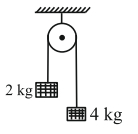
Two blocks of mass $2 \mathrm{~kg}$ and $4 \mathrm{~kg}$ are connected by a metal wire going over a smooth pulley as shown in figure. The radius of wire is $4.0 \times 10^{-5}$ $\mathrm{m}$ and Young's modulus of the metal is $2.0 \times 10^{11} \mathrm{~N} / \mathrm{m}^2$. The longitudinal strain developed in the wire is $\frac{1}{\alpha \pi}$. The value of $\alpha$ is [Use $\mathrm{g}=10 \mathrm{~m} / \mathrm{s}^2$ )
A mass M suspended from a spring of negligible mass. The spring is pulled a little and then released so that the mass executes S.H.M. of time period T. If the mass is increased by m, the time period becomes $\frac{5\text{T}}{3}.$ Then the ratio of $\frac{\text{m}}{\text{M}}$ is: