MCQ
If $\overrightarrow A \times \overrightarrow B=\overrightarrow B \times \overrightarrow A$ then the angle between $\overrightarrow A$ and $\overrightarrow B$ is
  • A
    $\pi / 2$
  • B
    $\pi / 3$
  • $\pi$
  • D
    $\pi / 4$

Answer

Correct option: C.
$\pi$
c
(c) We know that $\overrightarrow A \times \overrightarrow B = - (\overrightarrow B \times \overrightarrow A )$ because the angle between these two is always $90^°$.

But if the angle between $\overrightarrow A $ and $\overrightarrow B $ is $0^°$. Then $\overrightarrow A \times \overrightarrow B = \overrightarrow B \times \overrightarrow A = 0$.

Need a full question paper?

Generate a complete, print-ready paper with questions like this in minutes — across 16+ boards, with answer keys.
Start Generating Free

Similar questions

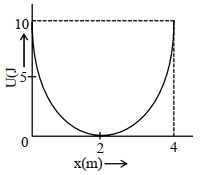
A mass of $5\, {kg}$ is connected to a spring. The potential energy curve of the simple harmonic motion executed by the system is shown in the figure. A simple pendulum of length $4\, {m}$ has the same period of oscillation as the spring system. What is the value of acceleration due to gravity on the planet where these experiments are performed? (In ${m} / {s}^{2}$)
If one end of a wire is fixed with a rigid support and the other end is stretched by a force of $10 \,N,$ then the increase in length is $0.5\, mm$. The ratio of the energy of the wire and the work done in displacing it through $1.5\, mm$ by the weight is
A car travels from $A$ to $ B $ at a speed of $20\,\,km/hr$ and returns at a speed of $30\,\,km/hr$. The average speed of the car for the whole journey is............$km/hr$
If the velocity of a particle is given by $v = {(180 - 16x)^{1/2}} m/s$, then its acceleration will be.......$ms^{-2}$
Which of the following statements is false
When an impurity is doped into an intrinsic semiconductor, the conductivity of the semiconductor:
  1. Increases.
  2. Decreases.
  3. Remains the same.
  4. Becomes zero.
Three rigid rods are joined to form an equilateral triangle ABC of side 1m. Three particles carrying charges $20\mu\text{C}$ each are attached to the vertices of the triangle. The whole system is at rest in an inertial frame. The resultant force on the charged particle at A has the magnitude:
  1. Zero
  2. 3.6N
  3. $3.6\sqrt{3}\text{N}$
  4. 7.2N.
Which of the following is not a unit of self-inductance
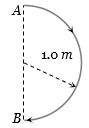
In $1.0\, s$ a particle goes from point $A$ to point $B$, moving in a semicircle of radius $1.0\, m$ (see figure). The magnitude of the average velocity is ......... $m/s$
A nonzero external force acts on a system of particles. The velocity and the acceleration of the centre of mass are found to be v0 and a0 at instant t. It is possible that: