Question
If $AB = 7.5\ cm$ and $CD = 2.5\ cm,$ construct a segment whose length is equal to:
$2AB + 3CD$

Answer

Given: $AB= 7.5cm$ and $CD = 2.5cm$ Draw $AB$ and $CD$

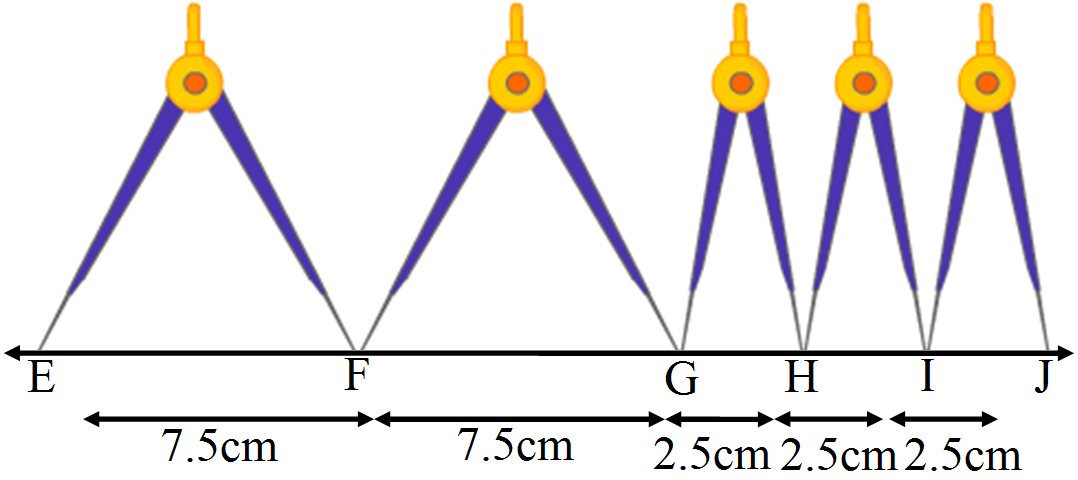
Draw a line/ and take point Eon it. Now, take a divider and open it such that the ends of both its arms are at $A$ and $B.$ Then, we lift the divider and place its one end at $E$ and other end (say $F$) on the line $1,$ as shown in the figure. Again, lift the divider and place its one end at $F$ and another end ($G$) on the line $1$, opposite to $E$. Now, reset the divider in such a way that the ends of its one hand are at $C$ and the end of other hand is at $D.$ Then, we lift the divider and place its one end at $G$ and another end (say $H$) on the line $1,$ opposite to $E$ as shown in the figure. Again, lift the divider and place its one end at $H$ and other end (say $I$) on the line $1,$ opposite to $E$ as shown in the figure. Again, lift the divider and place its one end at $I$ and another end (say $J$) on the line $1,$ opposite to $E$ as shown in the figure. $EG$ is required line segment, whose length is equal to $(2AB + 3CD).$
​​​​​​​

Need a full question paper?

Generate a complete, print-ready paper with questions like this in minutes — across 16+ boards, with answer keys.
Start Generating Free

Similar questions

Construct the angle with the help of ruler and compasses only: $135^\circ $
Draw a line segment $AB$ of length $10\ cm.$ Mark a point $P$ on $AB$ such that $AP = 4\ cm.$ Draw a line through $P$ perpendicular to $AB.$
Find the sum: $(– 7) + (– 9) + 4 + 16$
Draw a circle with centre at point O and radius 5 cm. Draw its chord AB, draw the perpendicular bisector of line segment AB. Does it pass through the centre of the circle?
Nandini's house is $\frac9{10} \ km$ from her school. She walked some distance and then took a bus for $\frac12 \ km$ to reach the shcool. How far did she walk?
Identify the symmetrical instruments from your mathematical instrument box.
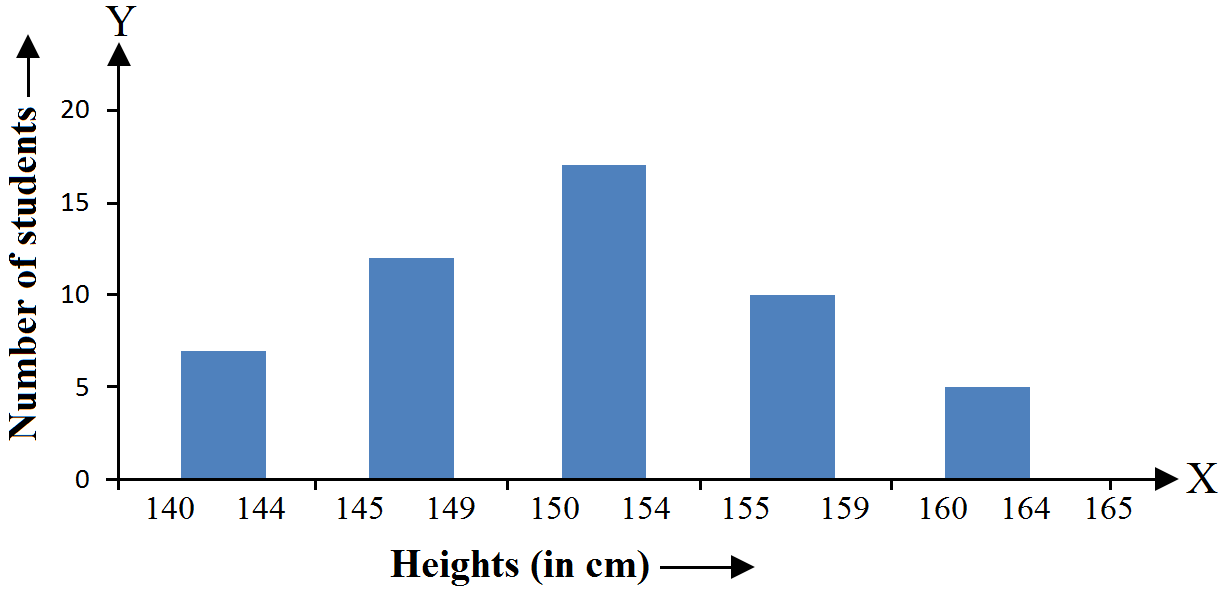
The following bar graph represent the heights $($in $cm)$ of $50$ students of Class $XI$ of a particular school. Study the graph and answer the following questions:

$i.\ $What percentage of the total number of students have their heights more than $149\ cm$?
$ii.\ $How many students in the class are in the range of maximum height of the class?
$iii.\ $The school wants to provide a particular type of tonic to each student below the height of $150\ cm$ to improve his height. If the cost of the tonic for each student comes out to be ₛ $55$, how much amount of money is required?
$iv.\ $How many students are in the range of shortest height of the class?
$v.\ $State whether true or false:
$a.\ $There are $9$ students in the class whose heights are in the range of $155-159\ cm.$
$b.\ $Maximum height $($in $cm)$ of a student in the class is $17.$
$c.\ $There are $29$ students in the class whose heights are in the range of $145-154\ cm.$
$d.\ $Minimum height $($in $cm)$ of a student is the class is in the range of $140-144\ cm.$
$e.\ $The number of students in the class having their heights less than $150\ cm$ is $12$.
$f.\ $There are $14$ students each of whom has height more than $154\ cm.$
Sarita bought $\frac25$ metre of ribbon and Lalita $\frac34$ metre of ribbon, What was the total length of the ribbon they bought?
The following table gives information about the circulation of newspapers (dailies) in a town in five languages.
Language: English Hindi Tamil Punjabi Gujarati
Number of newspapers: $5000$ $8500$ $500$ $2500$ $1000$
Prepare a pictograph of the above data, using a symbol of your choice, each representing $1000$ newspapers.
Calculate the area one of the shaded region given below (all measures are in cm):