Question
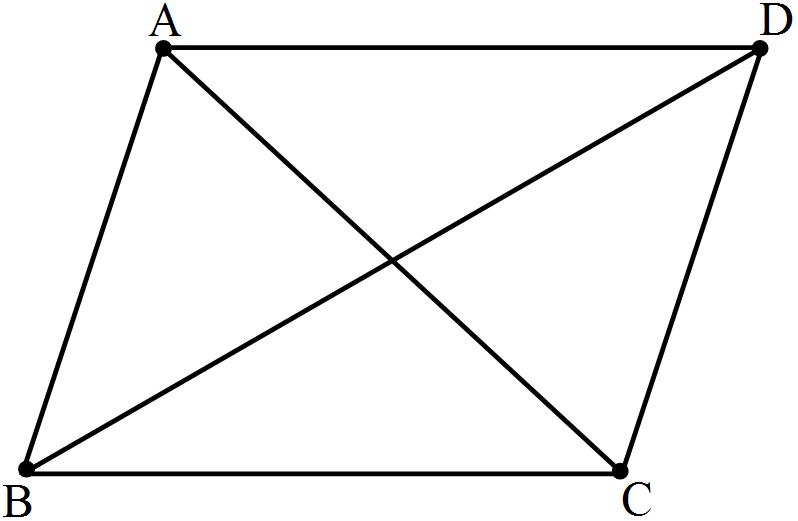
If $\text{ABCD}$ is a parallelogram, then prove that
$\text{ar}(\triangle\text{ABD})=\text{ar}(\triangle\text{BCD}) \ =\text{ar}(\triangle\text{ABC})=\text{ar}(\triangle\text{ACD})=\frac{1}{2}\text{ar} (\|^{ gm} \text{ABCD})$
Answer


Given, $\text{ABCD}$ is a parallelogram.
To prove: $\text{ar}(\triangle\text{ABD})=\text{ar}(\triangle\text{BCD})=\text{ar}(\triangle\text{ABC})$
$\ =\text{ar}(\triangle\text{ACD})=\frac{1}{2}\text{ar} (\|^{ gm} \text{ABCD})$
Proof: We know that diagonal of a parallelogram divides it into two equal triangles.
Since,$AC$ is the diagonal
Then, $\text{ar}(\triangle\text{ABC})=\text{ar}(\triangle\text{ACD})=\frac{1}{2}\text{ar} (\|^{ gm} \text{ABCD}) ...(1)$
Since, BD is the diagonal
Then $\text{ar}(\triangle\text{ABD})=\text{ar}(\triangle\text{BCD})=\frac{1}{2}\text{ar} (\|^{gm} \text{ABCD}) ...(2)$
Compare equation $(1)$ and $(2)$
$\therefore\text{ar}(\triangle\text{ABC})=\text{ar}(\triangle\text{ACD})=\text{ar}(\triangle\text{ABD})$
$\ =\text{ar}(\triangle\text{BCD})=\frac{1}{2}\text{ar} (\|^{ gm} \text{ABCD})$
Need a full question paper?

Generate a complete, print-ready paper with questions like this in minutes — across 16+ boards, with answer keys.

Start Generating Free

Similar questions

The diameter of a cylinder is 28cm and its height is 40cm. Find the curved surface, total surface area and the volume of the cylinder.
If two straight lines intersect in such a way that one of the angles formed measures 90°, show that each of the remaining angles measures 90°.
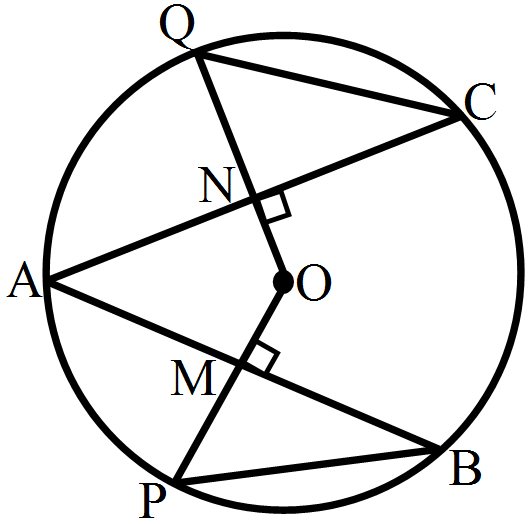
In the adjoining figure, O is the centre of a circle. If AB and AC are chords of the circle such that AB = AC, $\text{OP}\perp\text{AB}$ and $\text{OQ}\perp\text{AC},$
prove that PB = QC.
The following table shows the number of illiterate persons in the age group (10-58 years) in a town:
Age group (in years)
10-16
17-23
24-30
31-37
38-44
45-51
50-58
Number of illiterate persons
175
325
100
150
250
400
525
Draw a histogram to represent the above data. 
The polynomial $p(x) = x^4 - 2x^3 + 3x^2 - ax + b$ when divided by $(x - 1)$ and $(x + 1)$ leaves the remainders $5$ and $19$ respectively. Find the values of $a$ and $b$ Hence, find the remainder when $p(x)$ is divided by $(x - 2).$
If $\text{x}+\frac{1}{\text{x}}=3,$ calculate $\text{x}^2+\frac{1}{\text{x}^2},\ \text{x}^3+\frac{1}{\text{x}^3}$ and $\text{x}^4+\frac{1}{\text{x}^4}.$
The following data gives the value (in crores of rupees) of the Indian export of cotton textiles for different years: 
Years
1982–83
1983–84
1984–85
1985–86
1986–87
Value of exports of cotton textiles (in crores of rupees)
300
325
475
450
550
Represent the above data with the help of a bar graph. Indicate with the help of a bar graph the year in which the rate of increase in exports is maximum over the preceding year.
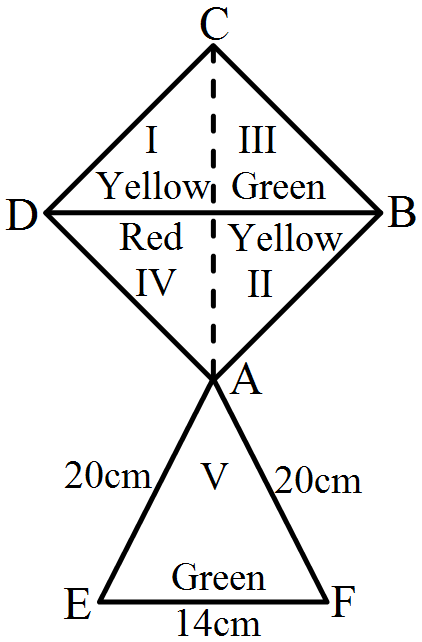
In the given figure, ABCD is a square with diagonal 44cm. How much paper of each shade is needed to make a kite given in the figure?
In the given figure, ABC is an equilateral triangle; PQ || AC and AC is produced to R such that CR = BP. Prove that QR bisects PC.
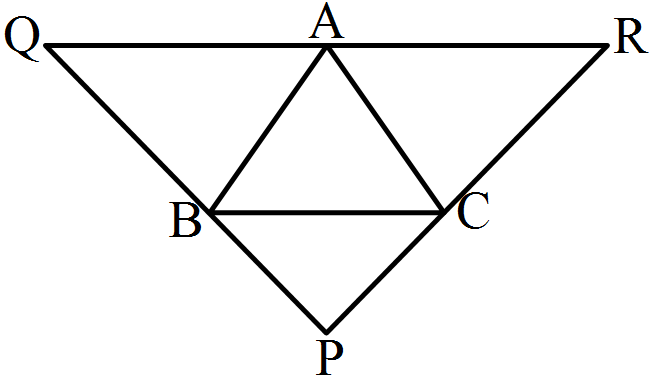
In the adjoining figure, $\triangle\text{ABC}$ is a triangle and through A, B, C, lines are drawn, parallel respectively to BC, CA and AB, intersecting at P, Q and R. Prove that the perimeter of $\triangle\text{PQR}$ is double the perimeter of $\triangle\text{ABC}.$