Question
If $ABCD$ is a parallelogram, then prove that $\text{ar}(\triangle\text{ABD})=\text{ar}(\triangle\text{BCD})\\ \ =\text{ar}(\triangle\text{ABC})=\text{ar}(\triangle\text{ACD})=\frac{1}{2}\text{ar}$ $(||^{gm} ABCD)$
Answer


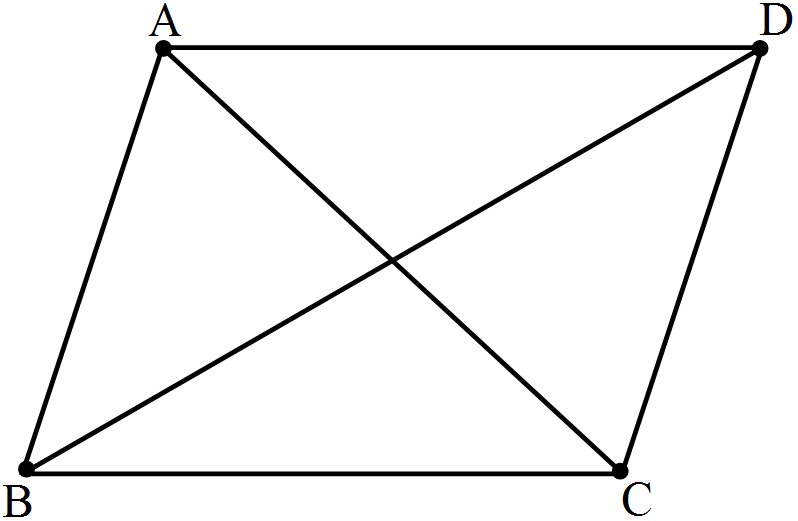
Given, $ABCD$ is a parallelogram.
To prove: $\text{ar}(\triangle\text{ABD})=\text{ar}(\triangle\text{BCD})=\text{ar}(\triangle\text{ABC})\\ \ =\text{ar}(\triangle\text{ACD})=\frac{1}{2}\text{ar}$ $(||^{gm} ABCD)$
Proof: We know that diagonal of a parallelogram divides it into two equal triangles.
Since, $AC$ is the diagonal
Then, $\text{ar}(\triangle\text{ABC})=\text{ar}(\triangle\text{ACD})=\frac{1}{2}\text{ar} (||^{gm} ABCD) ...(1)$
Since, $BD$ is the diagonal
Then $\text{ar}(\triangle\text{ABD})=\text{ar}(\triangle\text{BCD})=\frac{1}{2}\text{ar} (||^{gm} ABCD) ...(2)$
Compare equation $(1)$ and $(2)$
$\therefore\text{ar}(\triangle\text{ABC})=\text{ar}(\triangle\text{ACD})=\text{ar}(\triangle\text{ABD})\\ \ =\text{ar}(\triangle\text{BCD})=\frac{1}{2}\text{ar}$ ($||^{gm} ABCD$)

Need a full question paper?

Generate a complete, print-ready paper with questions like this in minutes — across 16+ boards, with answer keys.
Start Generating Free

Similar questions

In the given figure, $O$ is a point in the interior of square $ABCD$ such that $\triangle\text{OAB}$ is an equilateral triangle. Show that $\triangle\text{OCD}$ is an isosceles triangle.
$(x + y)^3 - (x - y)^3$ can be factorized as:
Two parallel lines $l$ and $m$ are intersected by a transversal $t$. Show that the quadrilateral formed by the bisectors of interior angles is a rectangle.
In the given figure, $O$ is the centre of the circle and $\angle\text{BCO}=30^\circ.$ Find $x$ and $y$.
Prove that the line segments joining the middle points of the sides of a triangle divide it into four congruent triangles.
The radius of a circle is $8\ cm$ and the length of one of its chords is $12\ cm$. Find the distance of the chord from the centre.
The runs scored by two teams $A$ and $B$ on the first $60$ balls in a cricket match are given below :
Number of balls Team A Team B
$1-6$ $2$ $5$
$7-12$ $1$ $6$
$13-18$ $8$ $2$
$19-24$ $9$ $10$
$25-30$ $4$ $5$
$31-36$ $5$ $6$
$37-42$ $6$ $3$
$43-48$ $10$ $4$
$49-54$ $6$ $8$
$55-60$ $2$ $10$
Represent the data of both the teams on the same graph by frequency polygons.
[Hint: First make the class intervals continuous.]
Draw a circle with center at point $O$ and radius $5\ cm.$ Draw its chord $AB,$ draw the perpendicular bisector of line segment $AB$. Does it pass through the center of the circle?
Find the perimeter and area of a qudrilateral $A B C D$ in which $B C=12\ cm, C D=9\ cm, B D=15\ cm, D A=17\ cm$ and $\angle ABD =90^{\circ}$.
Find the area of a triangular whose sides are $91\ m, 98\ m$ and $105\ m$ in length. Find the height corresponding to the longest side.