Question
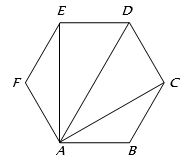
If $ ABCDEF$  is a regular hexagon and $\overrightarrow {AB} + \overrightarrow {AC} + \overrightarrow {AD} + \overrightarrow {AE} + \overrightarrow {AF} = \lambda \,\overrightarrow {AD} ,$ then $\lambda = $

Answer

b
(b) By triangle law, $\overrightarrow {AB} = \overrightarrow {AD} - \overrightarrow {BD} ,$

$\overrightarrow {AC} = \overrightarrow {AD} - \overrightarrow {CD} $
Therefore, $\overrightarrow {AB} + \overrightarrow {AC} + \overrightarrow {AD} + \overrightarrow {AE} + \overrightarrow {AF} $

= $3\overrightarrow {AD} + (\overrightarrow {AE} - \overrightarrow {BD} ) + (\overrightarrow {AF} - \overrightarrow {CD} ) = 3\overrightarrow {AD} $

Hence $\lambda = 3$, [Since $\overrightarrow {AE} = \overrightarrow {BD,} \,\overrightarrow {AF} \, = \overrightarrow {CD} ]$.
Need a full question paper?

Generate a complete, print-ready paper with questions like this in minutes — across 16+ boards, with answer keys.

Start Generating Free

Similar questions

Let $f$ be a differentiable function in the interval $(0, \infty)$ such that $f(1)=1$ and $\lim _{t \rightarrow x} \frac{t^2 f(x)-x^2 f(t)}{t-x}=1$ for each $x>0$. Then $2 f(2)+3 f(3)$ is equal to ....................
The equations of the sides $AB , BC$ and $CA$ of a triangle $ABC$ are: $2 x + y =0, x + py =21 a ,( a \neq 0)$ and $x-y=3$ respectively. Let $P(2, a)$ be the centroid of $\triangle ABC$. Then $( BC )^2$ is equal to $........$
Let $f :[-3,1] \rightarrow R$ be given as

$f(x)=\left\{\begin{array}{ll} \min \left\{(x+6), x^{2}\right\}, & -3 \leq x \leq 0 \\ \max \left\{\sqrt{x}, x^{2}\right\}, & 0 \leq x \leq 1 \end{array}\right.$

If the area bounded by $y = f ( x )$ and $x$ -axis is $A,$ then the value of $6 A$ is equal to ....... .

The number of arrangements of all digits of $12345$ such that atleast $3$ digits will not come in its position is
Let a smooth curve $y=f(x)$ be such that the slope of the tangent at any point $(x, y)$ on it is directly proportional to $\left(\frac{-y}{x}\right)$. If the curve passes through the point $(1,2)$ and $(8,1)$, then $\left| y \left(\frac{1}{8}\right)\right|$ is equal to
Let $y=y(x), x>1$, be the solution of the differential equation $(x-1) \frac{d y}{d x}+2 x y=\frac{1}{x-1}$, with $y(2)=\frac{1+e^{4}}{2 e^{4}}$. If $y(3)=\frac{e^{\alpha}+1}{\beta e^{\alpha}}$. then the value of $\alpha+\beta$ is equal to
At present, a firm is manufacturing $2000$ items. It is estimated that the rate of change of production $P$ w.r.t. additional number of workers $x$ is given by $\frac{{dp}}{{dx}} = 100 - 12\sqrt x $ . If the firm employs $25 $ more workers, then the new level of production of itmes is 
If $\log _{3} 2, \log _{3}\left(2^{x}-5\right), \log _{3}\left(2^{x}-\frac{7}{2}\right)$ are in an arithmetic progression, then the value of $x$ is equal to $.....$
Let the complex numbers $\alpha$ and $\frac{1}{\bar{\alpha}}$ lie on the circles $\left|z-z_0\right|^2=4$ and $\left|z-z_0\right|^2=16$ respectively, where $z_0=1+i$. Then, the value of $100|\alpha|^2$ is $........$
Let two circles $C_1$ and $C_2$ of radii $2$ and $4$ be tangent at point $P$ and tangent to a common straight line (not passing through $P$ ) at points $Q$ and $R$ , then value of $PQ^2 + QR^2 + RP^2$ is