MCQ
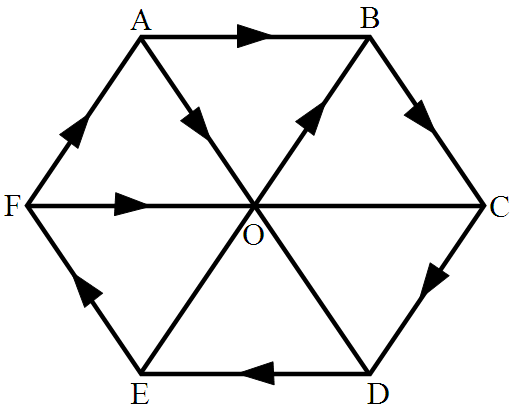
If $\text{ABCDEF}$ is a regular hexagon, then $\overrightarrow{\text{AD}}+\overrightarrow{\text{EB}}+\overrightarrow{\text{FC}}$ equals,
  • A
    $2\overrightarrow{\text{AB}}$
  • B
    $\vec0$
  • C
    $3\overrightarrow{\text{AB}}$
  • $4\overrightarrow{\text{AB}}$

Answer

Correct option: D.
$4\overrightarrow{\text{AB}}$

$\overrightarrow{\text{AD}}=2\overrightarrow{\text{BC}}$
$\overrightarrow{\text{EB}}=2\overrightarrow{\text{FA}}$
$\overrightarrow{\text{FC}}=2\overrightarrow{\text{AB}}$
$\overrightarrow{\text{AD}}+\overrightarrow{\text{EB}}=2\Big(\overrightarrow{\text{BC}}+\overrightarrow{\text{FA}}\Big)$
$=2\Big(\overrightarrow{\text{AO}}+\overrightarrow{\text{FA}}\Big)$ $\Big(\because\ \overrightarrow{\text{BC}}=\overrightarrow{\text{AO}}\Big)$
In triangle $\text{AOF},$
$\overrightarrow{\text{FA}}+\overrightarrow{\text{AO}}+\overrightarrow{\text{FO}}=0$
$\therefore\ \overrightarrow{\text{FA}}+\overrightarrow{\text{AO}}=-\overrightarrow{\text{FO}}$
$\therefore\overrightarrow{\text{AD}}+\overrightarrow{\text{EB}}=-2\overrightarrow{\text{FO}}$
And $\overrightarrow{\text{AB}}=-\overrightarrow{\text{FO}}$
$\therefore\overrightarrow{\text{AD}}+\overrightarrow{\text{EB}}=2\overrightarrow{\text{AB}}$
$\therefore\overrightarrow{\text{AD}}+\overrightarrow{\text{EB}}+\overrightarrow{\text{FC}}$
$=2\overrightarrow{\text{AB}}+2\overrightarrow{\text{AB}}$
$=4\overrightarrow{\text{AB}}$

Need a full question paper?

Generate a complete, print-ready paper with questions like this in minutes — across 16+ boards, with answer keys.

Start Generating Free

Similar questions

The principal value of ${\sin ^{ - 1}}\left[ {\sin \left( {\frac{{2\pi }}{3}} \right)} \right]$ is
If the position vectors of the points $A, B, C $ be $i + j,\,\,\,i - j$ and $a\,\,i + b\,j + c\,k$ respectively, then the points  $A, B, C $ are collinear if
Let $M$ be the set of all $2 \times 2$ matrices with entries from the set $R$ of real numbers. Then, the function $f : M\rightarrow R$ defined by $f(A) = |A|$ for every A \in M, is:
If $\tan ({\cos ^{ - 1}}x) = \sin \left( {{{\cot }^{ - 1}}\frac{1}{2}} \right)$, then  $x =$
Let $A, B$ and $C$  be three events, which are pair-wise independence and $\bar E$  denotes the complement of an event $E$ . If $P(A \cap B \cap C) = 0$  and  $P(C) > 0,$ then $P[(\bar A \cap \bar B)|\,C]$ is equal to
A random variable $X$ has the following probability distribution:
$X:$ $1$ $2$ $3$ $4$ $5$ $6$ $7$ $8$
$P(X):$ $0.15$ $0.23$ $0.12$ $0.10$ $0.20$ $0.08$ $0.07$ $0.05$
Find the events $E = \{X : X$ is a prime number$\}, F\{X :X < 4\},$ the probability $\text{P}(\text{E}\cup\text{F})$ is:
For a suitably chosen real constant $a$, let a function, $f: R-\{-a\} \rightarrow R$ be defined by $f(x)=\frac{a-x}{a+x} .$ Further suppose that for any real number $x \neq- a$ and $f( x ) \neq- a ,( fof )( x )= x .$ Then $f\left(-\frac{1}{2}\right)$ is equal to
The angle between the curves $y^2 = x$ and $x^2= y$ at $(1, 1)$ is :
If $y = \log \tan \sqrt x $ then the value of ${{dy} \over {dx}}$ is
If the diraction ratios of a line are proportional to 1, -3, 2, then its diraction cosines are: