MCQ
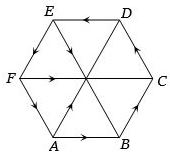
If $ABCDEF$ is regular hexagon, then $\overrightarrow {AD} \, + \overrightarrow {EB} + \overrightarrow {FC} = $
  • A
    $0$
  • B
    $2\overrightarrow {AB} $
  • C
    $3\overrightarrow {AB} $
  • $4\overrightarrow {AB} $

Answer

Correct option: D.
$4\overrightarrow {AB} $
d
(d)A regular hexagon  $ABCDEF.$

We know from the hexagon that $\overrightarrow {AD} $ is parallel to $\overrightarrow {BC} $ or $\overrightarrow {AD} = 2\,\overrightarrow {BC} $; $\overrightarrow {EB} $ is parallel to $\overrightarrow {FA} $

or $\overrightarrow {EB} = 2\overrightarrow {FA} $, and $\overrightarrow {FC} $ is parallel to $\overrightarrow {AB} $ or $\overrightarrow {FC} = 2\,\overrightarrow {AB} $.

Thus $\overrightarrow {AD} + \overrightarrow {EB} + \overrightarrow {FC} = 2\,\overrightarrow {BC} + 2\,\overrightarrow {FA} + 2\,\overrightarrow {AB} $

$ = 2(\overrightarrow {FA} + \overrightarrow {AB} + \overrightarrow {BC} ) = 2(\overrightarrow {FC} ) = 2(2\overrightarrow {AB} ) = 4\,\overrightarrow {AB} $.
Need a full question paper?

Generate a complete, print-ready paper with questions like this in minutes — across 16+ boards, with answer keys.

Start Generating Free

Similar questions

The surface area of a balloon of spherical shape being inflated, increases at a constant rate. If initially, the radius of balloon is $3$ units and after $5$ seconds, it becomes $7$ units, then its radius after $9$ seconds is
The locus of the point of instruction of the lines $\sqrt 3 x - y - 4 \sqrt 3 t = 0$  $\&$  $\sqrt 3tx + ty - 4\sqrt 3 = 0$  (where $ t$  is a parameter) is a hyperbola whose eccentricity is
A line meets $x$-axis and y-axis at the points $A$ and $B$ respectively. If the middle point of $AB$ be $({x_1},\;{y_1}),$ then the equation of the line is
Let $M =\left[\begin{array}{lll}0 & 1 & a \\ 1 & 2 & 3 \\ 3 & b & 1\end{array}\right]$ and adj $M =\left[\begin{array}{ccc}-1 & 1 & -1 \\ 8 & -6 & 2 \\ -5 & 3 & -1\end{array}\right]$ where $a$ and $b$ are real numbers. Which of the following options is/are correct?
$(1) \ a+b=3$
$(2)\ \operatorname{det}\left(\operatorname{adj} M ^2\right)=81$
$(3)\ (\operatorname{adj} M)^{-1}+\operatorname{adj} M^{-1}=-M$
$(4)$ If $M \left[\begin{array}{l}\alpha \\ \beta \\ \gamma\end{array}\right]=\left[\begin{array}{l}1 \\ 2 \\ 3\end{array}\right],$ then $\alpha-\beta+\gamma=3$
$1 + \cos 2x + \cos 4x + \cos 6x = $
If the system of equations, $a^2 x - ay = 1 - a$ & $bx + (3 - 2b) y = 3 + a$ possess a unique solution $x = 1, y = 1$ then :
$\mathop {\lim }\limits_{n \to \infty } \,\frac{{\sum\limits_{r = 0}^n {{{\tan }^{ - 1}}\left( {1 + r + {r^2}} \right)} }}{n}$ is equal to
If ${\log _2}x + {\log _x}2 = \frac{{10}}{3} = {\log _2}y + {\log _y}2$ and $x \ne y,$ then $x + y = $
The solution of the differential equation $x\frac{{dy}}{{dx}} + y = {x^2} + 3x + 2$ is
If ${x^p}{y^q} = {(x + y)^{p + q}}$, then $\frac{{{d^2}y}}{{d{x^2}}} = $