MCQ
If $\text{A}=\begin{bmatrix} 2 & -1 \\ 3 & -2 \end{bmatrix},$ then $A^n =$
  • A
    $\text{A}=\begin{bmatrix} 1 & 0 \\ 0 & 1 \end{bmatrix},$ if $n$ is an even natural number
  • B
    $\text{A}=\begin{bmatrix} 1 & 0 \\ 0 & 1 \end{bmatrix},$ if $n$ is an odd natural number
  • C
    $\text{A}=\begin{bmatrix} -1 & 0 \\ 0 & 1 \end{bmatrix},\text{if n}\in\text{N}$
  • None of these.

Answer

Correct option: D.
None of these.
$\text{A}=\begin{bmatrix} 2 & -1 \\ 3 & -2 \end{bmatrix}$
$\text{A}^2=\begin{bmatrix} 1 & 0 \\ 0 & 1 \end{bmatrix}=1$
If $n$ is an natural number.

Need a full question paper?

Generate a complete, print-ready paper with questions like this in minutes — across 16+ boards, with answer keys.

Start Generating Free

Similar questions

Choose the correct answer from the given four options. If $\cos^{-1}\alpha+\cos^{-1}\beta+\cos^{-1}\gamma=3\pi,$ then $\alpha(\beta+\gamma)+\beta(\gamma+\alpha)+\gamma(\alpha+\beta)$ equals$:$
The function $\text{f(x)=}\begin{cases}\frac{\text{e}\frac{1}{\text{x}}-1}{\text{e}\frac{1}{\text{x}}+1},&\text{x}\neq0\\0,&\text{x}=0\end{cases}$
  1. is continuous at x = 0
  2. is not continuous at x = 0
  3. is not continuous at x = 0, but can be made continuous at x = 0
  4. none of these.
The feasible solution of a LPP belongs to:
The plane $2\text{x}-(1-\lambda)\text{y}+3\lambda\text{z}=0$ passes through the intersection of the planes:
The function $\text{f(x)}=\sin^{-1}(\cos\text{x})$ is:
  1. Discontinuous at x = 0
  2. Continuous at x = 0
  3. Differentiable at x = 0
  4. None of these.
Let a vector $\vec{\text{r}}$ make angles 60°, 30° with it and y-axes respectively. Find the angle $\vec{\text{r}}$ make with z-axis:
  1. 30°
  2. 60°
  3. 90°
  4. 120°
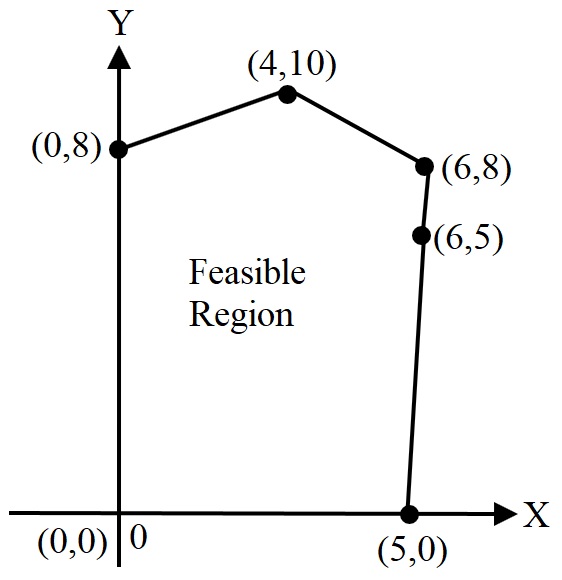
The feasible, region for an LPP is shown shaded in the figure. Let Z = 3x - 4y be the objective function. A minimum of Z occurs at:
  1. (0, 0)
  2. (0, 8)
  3. (5, 0)
  4. (4, 10)
The objective function Z = 4x + 3y can be maximised subjected to the constraints $ 3\text{x}+4\text{y}\leq24,$ $8\text{x}+6\text{y}\leq48,$ $\text{x}\leq5,\text{y}\leq6;\text{x},\text{y}\leq0.$
The area bounded by the curve $y = x^4 - 2x^3 + x^2 + 3$ with $x-$axis and ordinates corresponding to the minima of $y$ is:
If $f(x)=x^2+4 x-5$ and $A=\left|\begin{array}{ll}1 & 2 \\ 4 & -3\end{array}\right|$, then $f(A)$ is equal to