Question
If $A=\left[a_{i j}\right]=\left[\begin{array}{cc}2 & -1 \\ -3 & 4 \\ 1 & 2\end{array}\right]$ and $B=\left[b_{i j}\right]=\left[\begin{array}{ccc}2 & 3 & -5 \\ 1 & 4 & 9 \\ 0 & 7 & -2\end{array}\right]$, then value of $a_{11} b_{11}+a_{22} b_{22}$ is
Answer

(b) : We have, $A=\left[\begin{array}{cc}2 & -1 \\ -3 & 4 \\ 1 & 2\end{array}\right]$ and $B=\left[\begin{array}{ccc}2 & 3 & -5 \\ 1 & 4 & 9 \\ 0 & 7 & -2\end{array}\right]$
Here, $a_{11}=2, a_{22}=4, b_{11}=2, b_{22}=4$
$
\therefore \quad a_{11} b_{11}+a_{22} b_{22}=2(2)+4(4)=4+16=20
$

Need a full question paper?

Generate a complete, print-ready paper with questions like this in minutes — across 16+ boards, with answer keys.

Start Generating Free

Similar questions

$\int\limits^1_0\frac{\text{d}}{\text{dx}}\Big\{\sin^{-1}\Big(\frac{2\text{x}}{1+\text{x}^2}\Big)\Big\}\text{dx}$ is equal to:
  1. $0$
  2. ${\pi}$
  3. $\frac{\pi}{2}$
  4. $\frac{\pi}{4}$
If the feasible region for a solution of linear inequations is bounded, it is called as:
  1. Concave Polygon
  2. Finite Region
  3. Convex Polygon
  4. None of the above
The vectors $2\hat{\text{i}}+3\hat{\text{j}}-4\hat{\text{k}}$ and $\text{a}\hat{\text{i}}+\text{b}\hat{\text{j}}+\text{c}\hat{\text{k}}$ are perpendicular if:
  1. a = 2, b = 3, c = -4
  2. a = 4, b = 4, c = 5
  3. a = 4, b = 4, c = -5
  4. a = -4, b = 4, c = -5
If $A=\left|\begin{array}{lll}1 & 1 & 1 \\ 1 & 1 & 1 \\ 1 & 1 & 1\end{array}\right|$, then $A^2$ is$:$
If a matrix $A$ is such that $3A^3 + 2A^2 + 5A + I = 0,$ then $A^{-1}$ equal to:
The area bounded by the parabola $x^2=4 y$ and its latus rectum is:
If $\text{f(x)}=\begin{cases}\frac{\sin(\text{a}+1)}{\text{x}},&\text{x}<0\\\text{c},&\text{x}=0\\\frac{\sqrt{\text{x+bx}^2}-\sqrt{\text{x}}}{\text{bx}\sqrt{\text{x}}},&\text{x}>0&\end{cases}$ is continuouse at x = 0, then:
  1. $\text{a}=-\frac{3}{2},\text{b}=0,\text{c}=\frac{1}{2}$
  2. $\text{a}=-\frac{3}{2},\text{b}=1,\text{c}=-\frac{1}{2}$
  3. $\text{a}=-\frac{3}{2},\text{b}\in\text{R}-\{0\},\text{c}=\frac{1}{2}$
  4. $\text{None of these}.$
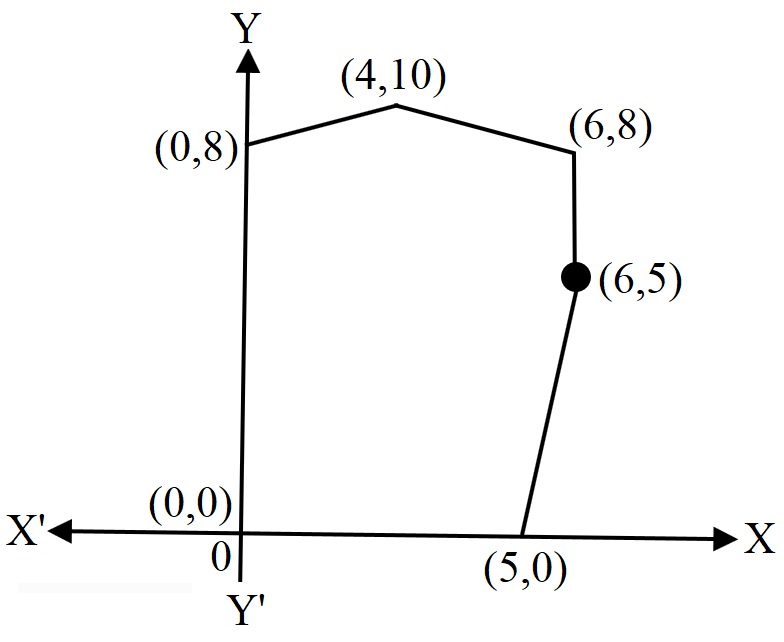
The feasible solution for a LPP is shown in the following figure. Let Z = 3x - 4y be the objective function.
Minimum of Z occurs at:
  1. (0, 0)
  2. (0, 8)
  3. (5, 0)
  4. (4, 10)
If A and B are non-singular matrices of same order with det(A) = 5, then $\operatorname{det}\left(B^{-1} A B\right)^2$ is is equal to.
Let R be the relation in the set {1, 2, 3, 4} given by R = {(1, 2), (2, 2), (1, 1), (4,4), (1, 3), (3, 3), (3, 2)}. Choose the correct answer.
  1. R is reflexive and symmetric but not transitive.
  2. R is reflexive and transitive but not symmetric.
  3. R is symmetric and transitive but not reflexive.
  4. R is an equivalence relation.