Question
If $A=\left[\begin{array}{cc}1 & 4 \\ 1 & -3\end{array}\right]$ and $B=\left[\begin{array}{cc}1 & 2 \\ -1 & -1\end{array}\right]$ Find:
$i. (A+B)^2$
$ii. A^2+B^2$
$iii.$ Is $(A+B)^2=A^2+B^2$ ?
Answer

$A+B=\left[\begin{array}{cc}1 & 4 \\ 1 & -3\end{array}\right]+\left[\begin{array}{cc}1 & 2 \\ -1 & -1\end{array}\right]$
$=\left[\begin{array}{cc}1+1 & 4+2 \\ 1-1 & -3-1\end{array}\right]  =\left[\begin{array}{cc}2 & 6 \\ 0 & -4\end{array}\right]$
Now, $( A + B )^2=( A + B )( A + B )$
$\begin{array}{l}=\left[\begin{array}{cc}2 & 6 \\ 0 & -4\end{array}\right]\left[\begin{array}{cc}2 & 6 \\ 0 & -4\end{array}\right] \end{array} $
$=\left[\begin{array}{cc}(2)(2)+(6)(0) & (2)(6)+(6)(-4) \\ (0)(2)+(-4)(0) & (0)(6)+(-4)(-4)\end{array}\right]  $
$ =\left[\begin{array}{cc}4 & -12 \\ 0 & 16\end{array}\right]$
$(ii)\ A^2=\left[\begin{array}{cc}1 & 4 \\ 1 & -3\end{array}\right]\left[\begin{array}{cc}1 & 4 \\ 1 & -3\end{array}\right] $
$=\left[\begin{array}{cc}1+4 & 4-12 \\ 1-3 & 4+9\end{array}\right]  $
$ =\left[\begin{array}{cc}5 & -8 \\ -2 & 13\end{array}\right]$
$B ^2=\left[\begin{array}{cc}1 & 2 \\ -1 & -1\end{array}\right]\left[\begin{array}{cc}1 & 2 \\ -1 & -1\end{array}\right]$
$\left[\begin{array}{cc}1-2 & 2-2 \\ -1+1 & -2+1\end{array}\right]$
$\left[\begin{array}{cc}-1 & 0 \\ 0 & -1\end{array}\right] A^2+B^2=\left[\begin{array}{cc}5 & -8 \\ -2 & 13\end{array}\right]+\left[\begin{array}{cc}-1 & 0 \\ 0 & -1\end{array}\right]$
$A ^2+ B ^2=\left[\begin{array}{cc}4 & -8 \\ -2 & 12\end{array}\right]$
$(iii)$ No $,(A+B)^2 \neq A^2+B^2$.

Need a full question paper?

Generate a complete, print-ready paper with questions like this in minutes — across 16+ boards, with answer keys.

Start Generating Free

Similar questions

A man has a choice to invest in hundred-rupee shares of two firms at Rs 120 or at Rs 132. The first firm pays a dividend of 5% per annum and the second firm pays a dividend of 6% per annum. Find:
(i) which company is giving a better return.
(ii) if a man invests Rs 26,400 with each firm, how much will be the difference between the annual returns from the two firms.
Solve the following linear in$-$equation and graph the solution set on a real number line: $\frac{1}{3}(5 x-8) \geq \frac{1}{2}(4 x-7), x \in R$
Estimate the median, the lower quartile and the upper quartile of the following frequency distribution by drawing an ogive: 
Marks  30-40 40-50 50-60 60-70 70-80 80-90 90-100
No. of boys  10 12 14 12 9 7 6
Draw a circle of radius 4 cm. Take a point P outside the circle without using the center at the circle. Draw two tangents to the circle from point P.
Prove that : $\frac{\tan \mathrm{A}}{1-\cot \mathrm{A}}+\frac{\cot \mathrm{A}}{1-\tan \mathrm{A}}=\tan \mathrm{A}+\cot \mathrm{A}+1$
Solve the following by reducing them to quadratic equations:
$\left(\frac{7 y-1}{y}\right)^2-3\left(\frac{7 y-1}{y}\right)-18=0, y \neq 0$
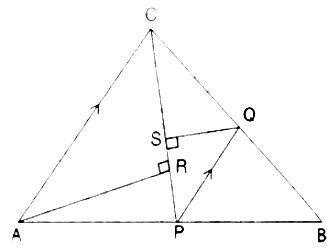
In the figure, given below, $P$ is a point on $AB$ such that $AP : PB = 4 : 3. PQ$ is parallel to $AC.$

(i) Calculate the ratio $PQ : AC,$ giving reason for your answer.
(ii) In triangle $ARC, \angle ARC = 90^\circ.$ Given $QS = 6\ cm,$ calculate the length of $AR.$
Prove.$\frac{\cos ^3 A+\sin ^3 A}{\cos A+\sin A}+\frac{\cos ^3 A-\sin ^3 A}{\cos A-\sin 3 A}=2$
A man observes the angle of elevation of the top of a building to be 30°. He walks towards it in horizontal line through its base. On covering 60 m, the angle of elevation changed to 60°. Find the height of the building.
The hypotenuse of a right angled triangle is $3 \sqrt{5}$. If the smaller side is tripled and the larger side is doubled, the new hypotenuse will be $15 \ cm.$ Find the length of each side.