Question
If $A=\left[\begin{array}{cc}3 & x-1 \\ 2 x+3 & x+2\end{array}\right]$ is a symmetric matrix, then $x=$
Answer

$(c)  \because A$ is a symmetric matrix $\Rightarrow A^T=A$
$\Rightarrow\left[\begin{array}{cc} 3 & 2 x+3 \\ x-1 & x+2 \end{array}\right]$
$=\left[\begin{array}{cc} 3 & x-1 \\ 2 x+3 & x+2 \end{array}\right] $
$\Rightarrow x-1=2 x+3$
$\Rightarrow x=-4 $

Need a full question paper?

Generate a complete, print-ready paper with questions like this in minutes — across 16+ boards, with answer keys.

Start Generating Free

Similar questions

The lines $\frac{\text{x}}{1}=\frac{\text{y}}{2}=\frac{\text{z}}{3}$ and $\frac{\text{x}-1}{-2}=\frac{\text{y}-2}{-4}=\frac{\text{z}-3}{-6}$ are:
  1. Parallel.
  2. Intersecting.
  3. Skew.
  4. Coincident.
If $\text{y}=\text{e}^{-\text{x}}(\text{A}\cos\text{x}+\text{B}\sin\text{x}),$ then y is a solution of:
  1. $\frac{\text{d}^2\text{y}}{\text{dx}^2}+2\frac{\text{dy}}{\text{dx}}=0$
  2. $\frac{\text{d}^2\text{y}}{\text{dx}^2}-2\frac{\text{dy}}{\text{dx}}+2\text{y}=0$
  3. $\frac{\text{d}^2\text{y}}{\text{dx}^2}+2\frac{\text{dy}}{\text{dx}}+2\text{y}=0$
  4. $\frac{\text{d}^2\text{y}}{\text{dx}^2}+2\text{y}=0$
For the following LPP, maximise $Z=3 x+4 y$ subject to constraints $x-y \geq-1, x \leq 3, x \geq 0, y \geq 0$ the maximum value is
What is the degree of the differential equation $y =x \frac{d y}{d x}+\left(\frac{d y}{d x}\right)^{-1}$ ?
If $\text{A}=\begin{vmatrix}\text{a}_{11}&\text{a}_{12}&\text{a}_{13}\\\text{a}_{21}&\text{a}_{22}&\text{a}_{23}\\\text{a}_{31}&\text{a}_{32}&\text{a}_{33}\end{vmatrix}$ and $C_{ij} $ is cofactor of $a_{ij}$ in $a,$ then value of $|A|$ is given by:
If $A, B$ are non-singular square matrices of the same order, then $\left(A B^{-1}\right)^{-1}=$
If $\triangle=\begin{vmatrix}a_{11}&a_{12}&a_{13}\\a_{21}&a_{22}&a_{23}\\a_{31}&a_{32}&a_{33}\end{vmatrix}$ and $A_{ij}$ is cofactors of $a_{ij},$ then value of $\triangle$ is given by:
Two persons $A$ and $B$ take turns in throwing a pair of dice.The first person to throw $9$ from both dice will be awarded the prize. If $A$ throws first, then the probability that $B$ wins the game is.
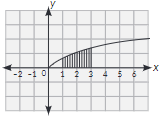
Shown below is the curve defined by the equation $y=\log (x+1)$ for $x \geq 0$.
Image
Which of these is the area of the shaded region?
The corner points of the feasible region determined by the system of linear inequalities are (0, 0), (4, 0), (2, 4) and (0, 5). If the maximum value of z = ax + by, where a, b > 0 occurs at both (2, 4) and (4, 0), then: