Question
If $A=\left[\begin{array}{ll}1 & 2 \\ 2 & 1\end{array}\right]$ and $B=\left[\begin{array}{ll}2 & 1 \\ 1 & 2\end{array}\right]$ Find $A(B A)$

Answer

$A=\left[\begin{array}{ll}1 & 2 \\ 2 & 1\end{array}\right], B=\left[\begin{array}{ll}2 & 1 \\ 1 & 2\end{array}\right]$
$\begin{array}{l}B A=\left[\begin{array}{ll}2 & 1 \\ 1 & 2\end{array}\right]\left[\begin{array}{ll}1 & 2 \\ 2 & 1\end{array}\right] \end{array} $
$ =\left[\begin{array}{ll}2+2 & 4+1 \\ 1+4 & 2+2\end{array}\right]  $
$ =\left[\begin{array}{ll}4 & 5 \\ 5 & 4\end{array}\right]$
$\begin{array}{l}A(B A)=\left[\begin{array}{ll}1 & 2 \\ 4 & 5\end{array}\right],\left[\begin{array}{ll}4 & 5 \\ 5 & 4\end{array}\right] \end{array} $
$ =\left[\begin{array}{cc}4+10 & 5+8 \\ 8+5 & 10+4\end{array}\right]  $
$ =\left[\begin{array}{ll}14 & 13 \\ 13 & 14\end{array}\right]$

Need a full question paper?

Generate a complete, print-ready paper with questions like this in minutes — across 16+ boards, with answer keys.
Start Generating Free

Similar questions

Prove.
$\frac{1+\sin A}{\operatorname{cosec} A-\cot A}-\frac{1-\sin A}{\operatorname{cosec} A+\cot A}=2(1+\cot A)$
The point P divides the join of $(2, 1)$ and $(−3, 6)$ in the ratio $2 : 3.$ Does P lies on the line $x − 5y + 15 = 0?$
ABCD is a cyclic quadrilateral AB and DC are produced to meet in E. Prove that Δ EBC ∼ Δ EDA.
Prove that $\frac{\sin 70^{\circ}}{\cos 20^{\circ}}+\frac{\operatorname{cosec} 20^{\circ}}{\sec 70^{\circ}}-2 \cos 70^{\circ} \times \operatorname{cosec} 20^{\circ}=0$.
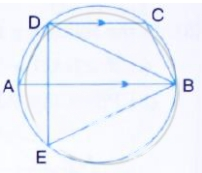
ABCD is a cyclic quadrilateral in which AB is parallel to DC and AB is a diameter of the circle. Given ∠BED = 65°; Calculate:
(i) ∠DAB, (ii) ∠BDC
Image
Prove.
$(\operatorname{cosec} A-\sin A )(\sec A -\cos A )(\tan A +\cot A )= 1$
If $p, q$ and $r$ in continued proportion, then prove the following:
$(p^2 - q^2)(q^2 + r^2) = (q^2 - r^2)(p^2 + q^2)$
Construct $\angle \mathrm{ABC}=120^{\circ}$, where $\mathrm{AB}=\mathrm{BC}=5 \mathrm{~cm}$. Mark two points $\mathrm{D}, \mathrm{E}$ which satisfy both the following conditions (a) equidistant from BA and BC (b) at a distance of 5 cm from B . Point E is on the side of reflex $\angle \mathrm{ABC}$. Join $\mathrm{AE}, \mathrm{EC}$, $C D$ and $A D$. Describe the figures (i) $A E C D$ (ii) $A B D$ (iii) $A B E$.
Given $A=\left[\begin{array}{ll}3 & 0 \\ 0 & 4\end{array}\right], B=\left[\begin{array}{ll}a & b \\ 0 & c\end{array}\right]$ and that $\ce{AB = A + B}.$ Find the values of $a, b$ and $c$
Find the sum of all natural numbers between $250$ and $1000$ which are divisible by $9.$