Question
If $A=\left[\begin{array}{ll}2 & 5 \\ 1 & 3\end{array}\right], B=\left[\begin{array}{cc}4 & -2 \\ -1 & 3\end{array}\right]$ and $I$ is Identity matrix of same order and $A^t$ is the transpose of matrix $A$ find $A^t \cdot B+B I$

Answer

$A=\left[\begin{array}{ll}2 & 5 \\ 1 & 3\end{array}\right]$
$\therefore A^t=\left[\begin{array}{ll}2 & 1 \\ 5 & 3\end{array}\right]$
$\begin{array}{l}A^t . B=\left[\begin{array}{ll}2 & 1 \\ 5 & 3\end{array}\right]\left[\begin{array}{cc}4 & -2 \\ -1 & 3\end{array}\right] \end{array} $
$ =\left[\begin{array}{ll}2 \times 4+1 \times(-1) & 2 \times(-2)+1 \times 3 \\ 3 \times 4+3 \times(-1) & 5 \times(-2)+3 \times 3\end{array}\right]  $
$ =\left[\begin{array}{cc}7 & -1 \\ 17 & -1\end{array}\right]$
$B .I=\left[\begin{array}{cc}4 & -2 \\ -1 & 3\end{array}\right]\left[\begin{array}{ll}1 & 0 \\ 0 & 1\end{array}\right]$
$=\left[\begin{array}{cc}4 & -2 \\ -1 & 3\end{array}\right]$
$\therefore A^t \cdot B+B I=\left[\begin{array}{cc}7 & -1 \\ 17 & -1\end{array}\right]+\left[\begin{array}{cc}4 & -2 \\ -1 & 3\end{array}\right]  $
$ =\left[\begin{array}{cc}11 & -3 \\ 16 & 2\end{array}\right]$

Need a full question paper?

Generate a complete, print-ready paper with questions like this in minutes — across 16+ boards, with answer keys.
Start Generating Free

Similar questions

If $x=\frac{\sqrt{m+n}+\sqrt{m-n}}{\sqrt{m+n}-\sqrt{m-n}}$ express n in terms of x and m
Pooja borrowed Rs 15,000 from Sonali at 11% p.a. compound interest. If she repays Rs 7,550 at the end of first year and Rs 6,101 at the end of second year, find the amount Pooja needs to give to Sonali at the end of third year to clear her debt.
A two digit number is $4$ times the sum of its digit and twice the product of its digit. Find the number.
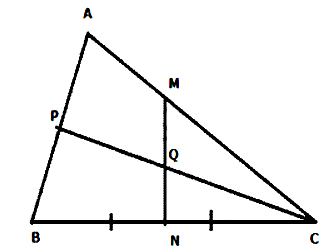
In the given figure ABC is a triangle. CP bisects angle ACB and MN is perpendicular bisector of BC. MN cuts CP at Q. Prove Q is equidistant from B and C, and also that Q is equidistant from BC and AC.
The line joining $P(-4, 5)$ and $Q(3, 2)$ intersects the y-axis at point $R. PM$ and $QN$ are perpendicular from $P$ and $Q$ on the x-axis Find:(i) the ratio $PR : RQ$
(ii) the coordinates of $R.$
(iii) the area of the quadrilateral $PMNQ.$
Take a graph paper and mark the points A(2,0), B(2,8) and C(S,4) on it. Taking AB as the line of symmetry, obtain and write the co-ordinates of point D. Complete the quadrilateral ABCD and give its geometrical name. 
Given $A=\left[\begin{array}{cc}2 & -6 \\ 2 & 0\end{array}\right], B=\left[\begin{array}{cc}-3 & 2 \\ 4 & 0\end{array}\right], C=\left[\begin{array}{ll}4 & 0 \\ 0 & 2\end{array}\right]$ Find the matrix $X$ such that $A+2 X=2 B+C$.
The value of a refrigerator depreciates by 8% of its value at the beginning of the year. Find the original value of the refrigerator if it depreciated by Rs 2,392 in the second year.
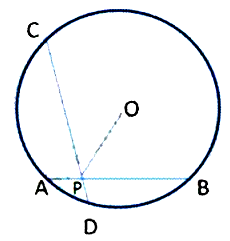
AB and CD are two equal chords of a drde intersecting at Pas shown in fig. P is joined to O , the centre of the cirde. Prove that OP bisects ∠ CPB.
Find the $31^{st}$ term of an A.P whose $10^{th}$ term is $38$ and the $16^{th}$ term is $74.$