Question
If $A=\left[\begin{array}{ll}3 & 1 \\ 2 & 1\end{array}\right]$ and $B=\left[\begin{array}{cc}1 & -2 \\ 5 & 3\end{array}\right],$ then show that $(A - B)^2 \neq A2 - 2AB + B^2.$

Answer

$\begin{array}{l}A-B=\left[\begin{array}{ll}3 & 1 \\ 2 & 1\end{array}\right]-\left[\begin{array}{cc}1 & -2 \\ 5 & 3\end{array}\right] \\ =\left[\begin{array}{ll}3-1 & 1+2 \\ 2-5 & 1-3\end{array}\right]=\left[\begin{array}{cc}2 & 3 \\ -3 & -2\end{array}\right]\end{array}$
$(A - B)^2 = (A - B)(A - B)$
$\begin{array}{l}\Rightarrow( A - B ) 2=\left[\begin{array}{cc}2 & 3 \\ -3 & -2\end{array}\right]\left[\begin{array}{cc}2 & 3 \\ -3 & -2\end{array}\right] \\ =\left[\begin{array}{cc}4-9 & 6-6 \\ -6+6 & -9+4\end{array}\right] \\ =\left[\begin{array}{cc}-5 & 0 \\ 0 & -5\end{array}\right]\end{array}$
$\begin{array}{l}\text { and } A^2=\left[\begin{array}{ll}3 & 1 \\ 2 & 1\end{array}\right]\left[\begin{array}{ll}3 & 1 \\ 2 & 1\end{array}\right] \\ =\left[\begin{array}{ll}9+2 & 3+1 \\ 6+2 & 2+1\end{array}\right]=\left[\begin{array}{cc}11 & 4 \\ 8 & 3\end{array}\right]\end{array}$
$\begin{array}{l}\text { and } B^2=\left[\begin{array}{cc}1 & -2 \\ 5 & 3\end{array}\right]\left[\begin{array}{cc}1 & -2 \\ 5 & 3\end{array}\right] \\ =\left[\begin{array}{cc}1-10 & -2-6 \\ 5+15 & -10+9\end{array}\right] \\ =\left[\begin{array}{cc}-9 & -8 \\ 20 & -1\end{array}\right]\end{array}$
$\begin{array}{l}\text { and } A B=\left[\begin{array}{ll}3 & 1 \\ 2 & 1\end{array}\right]\left[\begin{array}{cc}1 & -2 \\ 5 & 3\end{array}\right] \\ =\left[\begin{array}{ll}3+5 & -6+3 \\ 2+5 & -4+3\end{array}\right]=\left[\begin{array}{ll}8 & -3 \\ 7 & -1\end{array}\right]\end{array}$
$\begin{array}{l}\text { Now } A^2-2 A B+B^2 \\ =\left[\begin{array}{cc}11 & 4 \\ 8 & 3\end{array}\right]-2\left[\begin{array}{cc}8 & -3 \\ 7 & -1\end{array}\right]+\left[\begin{array}{cc}-9 & -8 \\ 20 & -1\end{array}\right] \\ =\left[\begin{array}{cc}11 & 4 \\ 8 & 3\end{array}\right]-\left[\begin{array}{ll}16 & -6 \\ 14 & -2\end{array}\right]+\left[\begin{array}{cc}-9 & -8 \\ 20 & -1\end{array}\right] \\ =\left[\begin{array}{cc}11-6-9 & 4+6-8 \\ 8-14+20 & 3+2-1\end{array}\right] \\ =\left[\begin{array}{cc}-14 & 2 \\ 14 & 4\end{array}\right]\end{array}$
Hence$,$ from above calculations, we get
$(A - B)^2 \neq A^2 - 2AB + B^2.$

Need a full question paper?

Generate a complete, print-ready paper with questions like this in minutes — across 16+ boards, with answer keys.

Start Generating Free

Similar questions

Calculate the mean of the distribution given below using the short cut method.
 
Marks 11 - 20 21 - 30 31 - 40 41 - 50 51 - 60 61 - 70 71 - 80
No. of students 2 6 10 12 9 7 4
A dealer in Jodhpur (Rajasthan) supplied floor tiles worth ₹ $ 17,00,000$ to a dealer in Delhi and another worth ₹ $ 3,00,000$ to a dealer in Jaipur (Rajasthan). The total value of his receipt of tiles in interstate transactions was ₹ $15,00,000$. If the rate of GST is $18 \%$, calculate the net IGST, CGST, and SGST payable by the dealer in Jodhpur.
Construct a frequency polygon without using a histogram for the following frequency distribution :
Class Mark10152025303540
Frequency420404530255
Construct a histogram and then a frequency polygon for the following frequency distribution.
Class Interval11-2021-3031-4041-5051-6061-70
Frequency152850352012
Prove.$\frac{\sin A+\cos A}{\cos A-\cos A}+\frac{\sin A-\cos A}{\sin A+\cos A}=\frac{2}{2 \sin ^2 A-1}$
Solve the equation $x^4 + 2x^3- 13x^2 + 2x + 1 = 0.$
Construct a frequency polygon without using a histogram for the following frequency distribution :
Class Interval 1-10 11-20 21-30 31-40 41-50
Frequency 8 12 10 16 6
The line segment joining the points A $(3, -4)$ and B $(-2, 1)$ is divided in the ratio $1 : 3$ at point P
in it. Find the co-ordinates of P. Also, find the equation of the line through P and perpendicular to the line $5x – 3y = 4.$
Solve the following quadratic equation using formula method only
$16x^2 - 24x = 1$
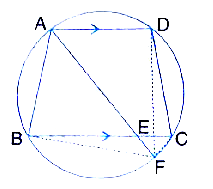
In the following figure, ABCD is a cyclic quadrilateral in which AD is parallel to BC.

If the bisector of angle A meets BC at point E and the given circle at point F, Prove that:
(i) EF = FC (ii) BF = DF