MCQ
If $A=\left[\begin{array}{lll}2 & -3 & 4\end{array}\right], B=\left[\begin{array}{l}3 \\ 2 \\ 2\end{array}\right], X=\left[\begin{array}{lll}1 & 2 & 3\end{array}\right]$ and $Y=\left[\begin{array}{l}2 \\ 3 \\ 4\end{array}\right]$, then $A B+X Y$ equals
  • $[28]$
  • B
    $[24]$
  • C
    $28$
  • D
    $24$

Answer

Correct option: A.
$[28]$
Consider, $A B=\left[\begin{array}{lll}2 & -3 & 4\end{array}\right]\left[\begin{array}{l}3 \\ 2 \\ 2\end{array}\right]$
$=[6-6+8]=[8]$
and $X Y=\left[\begin{array}{lll}1 & 2 & 3\end{array}\right]\left[\begin{array}{l}2 \\ 3 \\ 4\end{array}\right]$
$=[2+6+12]=[20]$
$A B+X Y=[8]+[20]=[28]$

Need a full question paper?

Generate a complete, print-ready paper with questions like this in minutes — across 16+ boards, with answer keys.

Start Generating Free

Similar questions

If $x = t^2, y = t^3$, then $\frac{\text{d}^2\text{y}}{\text{dx}^2} =$
Let $a, b$ and $c$ be vectors with magnitudes $3, 4$ and $5$ respectively and $a + b + c = 0,$ then the values of $a.b + b.c + c.a$ is:
Find area bounded by curves $\{(\text{x},\text{y}):\text{y}\geq\text{x}^2$ and ${y}=\text{x}\}$ :
length of the $1^{er}$ from the point $(0, -1, 3)$ to the plane $2x + y - 2z + 1 = 0$ is:
If ${x_1},{x_2},{x_3},{x_4}$ are roots of the equation ${x^4} - {x^3}\sin 2\beta + {x^2}\cos 2\beta - x\cos \beta - \sin \beta = 0,$ then ${\tan ^{ - 1}}{x_1} + {\tan ^{ - 1}}{x_2} + {\tan ^{ - 1}}{x_3} + {\tan ^{ - 1}}{x_4} = $
Let $\vec{\text{a}}=\text{a}_1\hat{\text{i}}+\text{a}_2\hat{\text{j}}+\text{a}_3\hat{\text{k}},\vec{\text{b}}=\text{b}_1\hat{\text{i}}+\text{b}_2\hat{\text{j}}+\text{b}_3\hat{\text{k}}$ and $\vec{\text{c}}=\text{c}_1\hat{\text{i}}+\text{c}_2\hat{\text{j}}+\text{c}_3\hat{\text{k}}$ be three zero vectors such that $\vec{\text{c}}$ is a unit vector perpendicular to both $\vec{\text{a}}$ and $\vec{\text{b}}.$ If the angle between $\vec{\text{a}}$ and $\vec{\text{b}}$ is $\frac{\pi}{6},$ then $\begin{vmatrix}\text{a}_1&\text{a}_2&\text{a}_3\\\text{b}_1&\text{b}_2&\text{b}_3\\\text{c}_1&\text{c}_2&\text{c}_3 \end{vmatrix}^2$ is equal to:
If $l, m, n$ are the $d.cs$ of the line joining $(5, -3, 8)$ and $(6, -1, 6)$ then $l + m + n =$
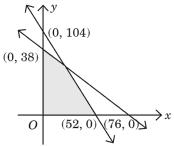
The feasible region of an LPP is given in the following figure
Image
Then, the constraints of the LPP are $x \geq 0, y \geq 0$ and
Let $f(x) = x^2-3 x+2$ then area bounded by the curve $f(∣x∣)\ ($in square units$)$ and $x -$ axis is :
If $\text{f}(\text{x})=\text{e}^{\text{x}}\sin\text{x}$ in $[0,\pi],$ then c in Rolle's theorem is: