MCQ
If an α-particle collides head$-$on with a nucleus, what is its impact parameter?
  • Zero
  • B
    Infinite
  • C
    $10-10m$
  • D
    $1010 m$

Answer

Correct option: A.
Zero
The perpendicular distance between the path of a projectile and the center of the potential field is the impact parameter.
Therefore, for a head$-$on collision of the $\alpha -$particle with a nucleus, the impact parameter is equal to zero.

Need a full question paper?

Generate a complete, print-ready paper with questions like this in minutes — across 16+ boards, with answer keys.
Start Generating Free

Similar questions

A current i ampere flows along the inner conductor of a coaxial cable and returns along the outer conductor of the cable, then the magnetic induction at any point outside the conductor at a distance r metre from the axis is
Two equal charges $q$ of opposite sign separated by a distance $2a$ constitute an electric dipole of dipole moment $p$. If $P$ is a point at a distance $r$ from the centre of the dipole and the line joining the centre of the dipole to this point makes an angle $\theta $ with the axis of the dipole, then the potential at $P$ is given by $(r > > 2a)$ (Where $p = 2qa$)
$A$ long straight wire is placed along the axis of a circular ring of radius $R$. The mutual inductance of this system is
A particular emission line, detected in the light from a galaxy, has a wavelength $\lambda^{\prime}=1.1 \lambda$, where $\lambda$ is the proper wavelength of the line. The galaxy distance from us
A potentiometer is an accurate and versatile device to make electrical measurements of $EMF$ because the method involves 
The output of a dynamo using a splitting commutator is
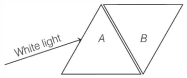
Consider two equivalent, triangular hollow prisms $A$ and $B$ made of thin glass plates and arranged with negligible spacing as shown in the figure. A beam of white light is incident on prism $A$ from the left. Given that, the refractive index of water is inversely related to temperature, the beam to the right of prism $B$ would not appear white, if
In a radioactive sample, ${ }_{10}^a K$ nuclei either decay into stable ${ }_{20}^{* 0} Ca$ nuclei with decay constant $4.5 \times 10^{-10}$ per year or into stable ${ }_{18}^{40}$ Ar muclei with decay constant $0.5 \times 10^{-10}$ per year. Given that in this sample all the stable ${ }_{20}^{\infty 0} Ca$ and ${ }_{15}^{20} Ar$ nuclei are produced by the ${ }_{19}^{* 0} K$ muclei only. In time $t \times 10^{\circ}$ years, if the ratio of the sum of stable ${ }_{30}^{40} Ca$ and ${ }_{15} \operatorname{An}$ nuclei to the radioactive ${ }_{19} K$ muclei is $99$ , the ralue of $t$ will be : [Given $\ln 10=2.3]$
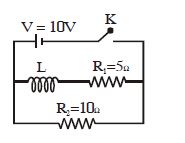
In the circuit show below, the key $K$ is closed at $t = 0$ . The current through the battery is
A charge of $4.0 \mu \mathrm{C}$ is moving with a velocity of $4.0 \times 10^6 \mathrm{~ms}^{-1}$ along the positive $\mathrm{y}$-axis under a magnetic field $\vec{B}$ of strength $(2 \hat{k})\  T$. The force acting on the charge is $x \hat{i} N$. The value of $x$ is__________.