If an electric heater is rated at $1000\, W$, then the time required to heat one litre of water from $20\,^oC$ to $60\,^oC$ is
Medium


Download our appand get started for free
Experience the future of education. Simply download our apps or reach out to us for more information. Let's shape the future of learning together!No signup needed.*
Similar Questions
- 1A certain piece of silver of given mass is to be made like a wire. Which of the following combination of length $(L)$ and the area of cross-sectional $(A) $ will lead to the smallest resistanceView Solution
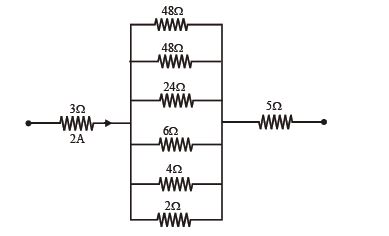
- 2Find potential difference across $24\,\Omega $ ............. $\mathrm{volt}$View Solution
- 3The heating coils rating at $220\, volt$ and producing $50\, cal/sec$ heat are available with the resistances $55\,\Omega $ , $110\,\Omega$ , $220\,\Omega $ and $440\,\Omega $. The heater of maximum power will be of............. $\Omega$View Solution
- 4Resistance of $100\, cm$ long potentiometer wire is $10 \,\Omega$, it is connected to a battery ($2\, volt$) and a resistance $R$ in series. A source of $10\, mV$ gives null point at $40\, cm$ length, then external resistance $R$ is ........... $\Omega $View Solution
- 5A $60\, watt$ bulb carries a current of $0.5\, amp$. The total charge passing through it in $1$ hour is ............ $coulomb$View Solution
- 6$n$ identical bulbs, each designed to draw a power $p$ from a certain voltage supply, are joined in series across that supply. The total power which they will draw isView Solution
- 7If current in an electric bulb changes by $1\%$, then the power will change by ............ $\%$View Solution
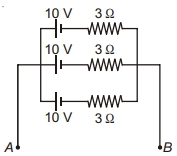
- 8Three identical cells are connected in parallel across $A B$. Net emf across $A B$ is .......... $V$View Solution
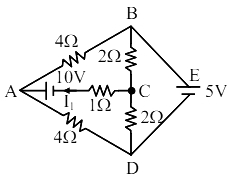
- 9The current flowing through the $1 \Omega$ resistor is $\frac{\mathrm{n}}{10} \ A. $ The value of $n$ is. . . . . . .View Solution
- 10The drift velocity of free electrons in a conductor is ‘$v$’ when a current ‘$i$’ is flowing in it. If both the radius and current are doubled, then drift velocity will beView Solution