Question
If an electron has a wavelength, does it also have a colour?

Answer

Colour is a characteristic of electromagnetic waves. Electrons behave as a de-Broglie wave because of their velocity. A de-Broglie wave is not an electromagnetic wave and is one dimensional. Hence, no colour is shown by an electron.

Need a full question paper?

Generate a complete, print-ready paper with questions like this in minutes — across 16+ boards, with answer keys.
Start Generating Free

Similar questions

What is Curie law in magnetism?
The amount of electric charge passing through a cross$-$section of wire in time t is $Q (t) = At^2 + Bt + C$
Where $A, B$ and $C$ are constants having values $5, 4$ and $1$ respectively.
Calculate the value of electric current at $t = 4s.$
Each side of a square is 90 cm long. At its corners $-2,+3,-4$ and +5 micro coulomb charges are placed respectively. Find the electric potential at the centre of the square.
A straight solenoid of length $50 \ cm$ has $1000$ turns and a mean cross $-$ sectional area of $2 \times 10^{-4} m^2$. It is placed with its axis at $30^{\circ}$, with a uniform magnetic field of $0.32 T$ . Find the torque acting on the solenoid when a current of $2 A$ is passed through it.
Prove that the electric field at the surface of a charged conductor is $\overrightarrow{ E }=\frac{\sigma}{\varepsilon_0} \hat{n}$. Where, $\sigma$ - Surface charge density, $\hat{n}$ - unit vector normal to the surface and in going outward direction.
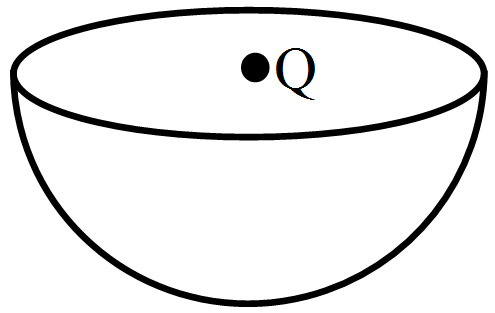
A charge $Q$ is placed at the centre of an imaginary hemispherical surface. Using symmetry arguments and the Gauss's law, find the flux of the electric field due to this charge through the surface of the hemisphere $($figure$).$
Explain that the nature of electron motion in a solid is very different from that in an isolated atom.
Give explanation of linearly pofarized, unpolarized and plane polarized wave.
Write the formula for the potential energy of a dipole in an electric field and find its minimum and maximum values.
$1 F\ ($farad$)$ is a very large unit for practical purposes. Explain with example.