Question
If an electron has a wavelength, does it also have a colour?

Answer

Colour is a characteristic of electromagnetic waves. Electrons behave as a de-Broglie wave because of their velocity. A de-Broglie wave is not an electromagnetic wave and is one dimensional. Hence, no colour is shown by an electron.

Need a full question paper?

Generate a complete, print-ready paper with questions like this in minutes — across 16+ boards, with answer keys.
Start Generating Free

Similar questions

An astronaut, by mistake, drops his food packet from an artificial satellite orbiting around the earth. Will it reach the surface of the earth? Why?
You are standing with your bag in your hands, on the ice in the middle of a pond. The ice is so slippery that it can offer no friction. How can you come out of the ice?
A diatomic gas is suddenly compressed to 1/4 of its initial volume. Find the ratio of final and initial pressure $(\gamma = 1.5)$.
A disc rotates about its axis with a constant angular acceleration of 4rad/s2. Find the radial and tangential accelerations of a particle at a distance of 1cm from the axis at the end of the first second after the disc starts rotating.
Prove that the angular momentum of a single particle moving with a constant velocity around a point remains constant throughout its motion.(NCERT)
What is mean free path of a gas molecule? On which factors does the mean free path depend?
Can you ever have a situation in which a light ray goes undeviated through a prism?
These days people use steel utensils with copper bottom. This is supposed to be good for uniform heating of food. Explain this effect using the fact that copper is the better conductor.
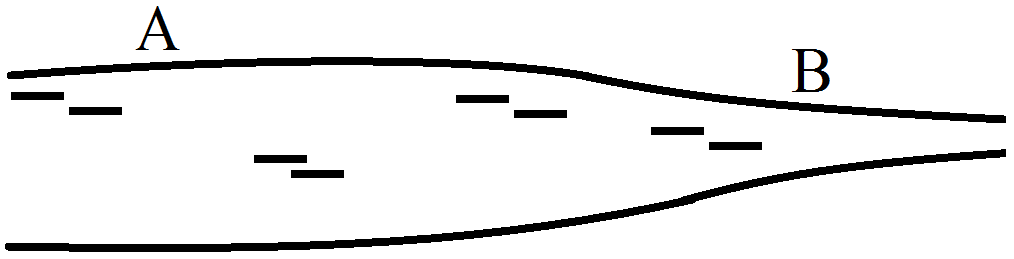
Water flows through a horizontal tube of variable cross-section. The area of cross-section at A and B are 4mm2 and 2mm2 respectively. If 1cc of water enters per second through A, find,
  1. The speed ofwater at A.
  2. The speed of water at B.
  3. Thepressure difference PA - PB.

A wire, carrying a current i, is kept in the x−y plane along the curve $\text{y}=\text{A}\sin\Big(\frac{2\pi}{\lambda}\text{x}\Big).$ A magnetic field B exists in the z direction. Find the magnitude of the magnetic force on the portion of the wire between $\text{x}=0$ and $\text{x}=\lambda.$