MCQ
If an electron moves from rest from a point at which potential is $50$ volt to another point at which potential is $70$ volt, then its kinetic energy in the final state will be
 
  • A
    $3.2 \times 10^{-10} \mathrm{~J}$
  • $3.2 \times 10^{-18} \mathrm{~J}$
  • C
    $1 N$
  • D
    $1$ dyne

Answer

Correct option: B.
$3.2 \times 10^{-18} \mathrm{~J}$

Need a full question paper?

Generate a complete, print-ready paper with questions like this in minutes — across 16+ boards, with answer keys.

Start Generating Free

Similar questions

In Bohr's atomic model of hydrogen, let $K$, $P$ and $E$ are the kinetic energy, potential energy and total energy of the electron respectively. Choose the correct option when the electron undergoes transitions to a higher level
In a circuit with a coil of resistance 2 ohms, the magnetic flux changes from 2.0 Wb to 10.0 Wb in 0.2 second. The charge that flows in the coil during this time is
The potential at a point due to an electric dipole will be maximum and minimum when the angles between the axis of the dipole and the line joining the point to the dipole are respectively
A common transistor radio set requires $12\,V (D.C.)$ for its operation. The $D.C.$ source is constructed by using a transformer and a rectifier circuit, which are operated at $220\, V$ $(A.C.)$ on standard domestic $A.C.$ supply. The number of turns of secondary coil are $24,$ then the number of turns of primary are
The operation of a nuclear reactor is said to be critical, if the multiplication factor $(K)$ has a value
The dipole moment of a circular loop carrying a current $I$, is $m$ and the magnetic field at the centre of the loop is $B_1$ . When the dipole moment is doubled by keeping the current constant, the magnetic field at the centre of the loop is $B_2$ . The ratio $\frac{{{B_1}}}{{{B_2}}}$ is
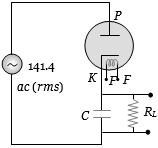
An alternating voltage of $141.4\,V$ (rms) is applied to a vacuum diode as shown in the figure. The maximum potential difference across the condenser will be......$V$
Doppler's effect in sound in addition to relative velocity between source and observer, also depends while source and observer or both are moving. Doppler effect in light depend only on the relative velocity of source and observer. The reason of this is
The equation $E = pc$ is valid:
When an impurity is doped into an intrinsic semiconductor, the conductivity of the semiconductor: