MCQ
If an emitter current is changed by $4\, mA ,$ the collector current changes by $3.5\, mA$. The value of $\beta$ will be
  • $7$
  • B
    $0.5$
  • C
    $0.875$
  • D
    $3.5$

Answer

Correct option: A.
$7$
a
$I _{\varepsilon}= I _{ C }+ I _{ B }$

$\Rightarrow \Delta I _{\varepsilon}=\Delta I _{ C }+\Delta I _{ B }$

$4 mA =3.5 mA +\Delta I _{ B }$

$\Rightarrow \Delta I _{ B }=0.5 mA$

$\Rightarrow \beta=\frac{\Delta I _{ C }}{\Delta I _{ B }}$

$\beta=\frac{3.5}{0.5}$

$\Rightarrow \beta=7$

Need a full question paper?

Generate a complete, print-ready paper with questions like this in minutes — across 16+ boards, with answer keys.

Start Generating Free

Similar questions

Polarisation of light establishes:
Displacement current is given by
A moving conductor coil in a magnetic field produces an induced $e.m.f$. This is in accordance with
The capacity of a condenser in which a dielectric of dielectric constant $5$ has been used, is $C$. If the dielectric is replaced by another with dielectric constant $20$, the capacity will become
Express which of the following setups can be used to verify Ohm’s law
The ratio of magnetic moments of two bar magnet is $13 : 5$. These magnets are held together in a vibration magnetometer are allowed to oscillate in earth’s magnetic field with like poles together $15$ oscillation per minute are made. What will be the frequency of oscillation of system if unlike poles are together....$oscillations/min$
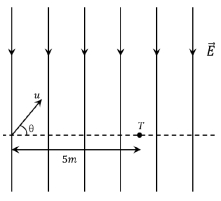
A uniform electric field, $\vec{E}=-400 \sqrt{3} \hat{y} NC ^{-1}$ is applied in a region. A charged particle of mass $m$ carrying positive charge $q$ is projected in this region with an initial speed of $2 \sqrt{10} \times 10^6 ms ^{-1}$. This particle is aimed to hit a target $T$, which is $5 m$ away from its entry point into the field as shown schematically in the figure. Take $\frac{ q }{ m }=10^{10} Ckg ^{-1}$. Then-

$(A)$ the particle will hit $T$ if projected at an angle $45^{\circ}$ from the horizontal

$(B)$ the particle will hit $T$ if projected either at an angle $30^{\circ}$ or $60^{\circ}$ from the horizontal

$(C)$ time taken by the particle to hit $T$ could be $\sqrt{\frac{5}{6}} \mu s$ as well as $\sqrt{\frac{5}{2}} \mu s$

$(D)$ time taken by the particle to hit $T$ is $\sqrt{\frac{5}{3}} \mu s$
The light source will be coherent if :
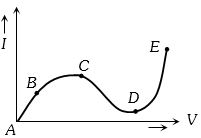
From the graph between current $I$ and voltage $V$ shown below, identify the portion corresponding to negative resistance
'Albedo' is