Question
If $\angle\text{A}$ and $\angle\text{B}$ are acute angles such that $\tan\text{A}=\tan\text{B}$ then prove that $\angle\text{A}=\angle\text{B}.$
Answer

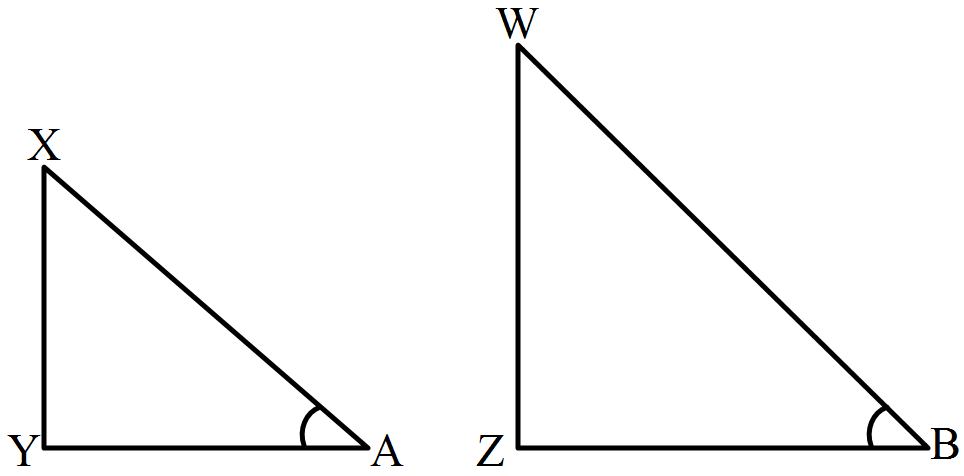
Consider two right $\triangle\text{XAY}$ and WBZ such that $\tan\text{A}=\tan\text{B}$

We have,
$\tan\text{A}=\frac{\text{XY}}{\text{XA}}$ and $\tan\text{B}=\frac{\text{WZ}}{\text{WB}}$
Since $\tan\text{A}=\tan\text{B}$
$\Rightarrow\frac{\text{XY}}{\text{AY}}=\frac{\text{WZ}}{\text{BZ}}$
$\Rightarrow\frac{\text{XY}}{\text{WZ}}=\frac{\text{AY}}{\text{BZ}}=\text{k}(\text{say})\dots(\text{i})$
$\Rightarrow\text{XY}=\text{k}\times\text{WZ}$ and $\text{AY}=\text{k}\times\text{BZ}\dots(\text{ii})$
Using Pythagoras theoram in $\triangle\text{XAY}$ and WBZ, we have
$\text{XA}^2=\text{XY}^2+\text{AY}^2$ and $\text{WB}^2=\text{WZ}^2+\text{BZ}^2$
$\Rightarrow\text{XA}^2={\text{k}^2\text{WZ}^2+\text{k}^2\text{BZ}^2}$ and $\text{WB}^2={\text{WZ}^2+\text{BZ}^2}$
$\Rightarrow\text{XA}^2={\text{k}^2\big(\text{WZ}^2+\text{BZ}^2}\big)$ and $\text{WB}^2={\text{WZ}^2+\text{BZ}^2}$
$\Rightarrow\frac{\text{XA}^2}{\text{WB}^2}=\frac{\text{k}^2\big({\text{WZ}^2+\text{BZ}^2\big)}}{\big({\text{WZ}^2+\text{BZ}^2\big)}}=\text{k}^2$
$\Rightarrow\frac{\text{XA}}{\text{WB}}=\text{k}\dots(\text{iii})$
From (i), (ii) and (iii), we get
$\frac{\text{XY}}{\text{WZ}}=\frac{\text{AY}}{\text{BZ}}=\frac{\text{XA}}{\text{WB}}$
$\Rightarrow\triangle\text{AYX}\sim\triangle\text{BZW}$
$\Rightarrow\angle\text{A}=\angle\text{B}$

Need a full question paper?

Generate a complete, print-ready paper with questions like this in minutes — across 16+ boards, with answer keys.

Start Generating Free

Similar questions

A train covered a certain distance at a uniform speed. If the train could have been 10km/hr. faster, it would have taken 2 hours less than the scheduled time. And, if the train were slower by 10km/hr. it would have taken 3 hours more than the scheduled time. Find the distance covered by the train.
The length of a rectangular park is twice its breadth, and its perimeter measures 840m. Find the area of the park.
Prove the following trigonometric identities.
If $\text{cosec }\theta-\sin\theta=\text{a}^3,\sec\theta-\cos\theta=\text{b}^3,$ prove that $a^2b^2 (a^2 + b^2) = 1.$
An aircraft has 120 passenger seats. The number of seats occupied during 100 flights is given in the following table:
Number of seats
100-104
104-108
108-112
112-116
116-120
Frequency
15
20
32 18 15
Determine the mean number of seats occupied over the flights.
The areas of two similar triangles are 121cm$^2$ and 64cm$^2$ respectively. If the median of the first triangle is 12.1cm, find the corresponding median of the other.
Solve the following quadratic equation by factorization:
$3\Big(\frac{3\text{x}-1}{2\text{x}+3}\Big)-2\Big(\frac{2\text{x}+3}{3\text{x}-1}\Big)=5,$ $\text{x}\neq\frac{1}{3},-\frac{3}{2}$
Solve the following systems of equations:
$\frac{\text{xy}}{\text{x}+\text{y}}=\frac{6}{5}$
$\frac{\text{xy}}{\text{y}-\text{x}}=6$ where $\text{x}+\text{y}\neq0,\text{y}-\text{x}\neq0.$
A hemispherical tank, full of water, is emptied by a pipe at the rate of $\frac{25}{7}$. How much time will it take to empty half the tank if the diameter of the base of the tank is 3 m ?
Find the roots of the following equations, if they exist, by applying the quadratic formula:
$15x^2 - 28 = x$
Find other zeroes of the polynomial $p(x)=3 x^4-4 x^3-10 x^2+8 x+8$ if two of its zeroes are $\sqrt{2}$ and $-\sqrt{2}$.