Question
If $\begin{bmatrix}2&\text{amp; }3\\4&\text{amp; }4\end{bmatrix}+\begin{bmatrix}\text{x}&\text{amp; }3\\\text{y}&\text{amp; }1\end{bmatrix}=\begin{bmatrix}10&\text{amp; }6\\8&\text{amp; }5\end{bmatrix}$ then $(\text{x, y})=$
  1. (4, 8)
  2. (8, 4)
  3. (1, 2)
  4. (2, 4)

Answer

  1. (8, 4)

Solution:

2 + x = 10 or x = 8

4 + y = 8 or y = 4

Need a full question paper?

Generate a complete, print-ready paper with questions like this in minutes — across 16+ boards, with answer keys.

Start Generating Free

Similar questions

Let $\mathrm{f}:(-1, \infty) \rightarrow \mathrm{R}$ be defined by $\mathrm{f}(0)=1$ and $f(x)=\frac{1}{x} \log _{e}(1+x), x \neq 0 .$ Then the function $f$
The value of $\tan\bigg[\frac{1}{2}\cos^{-1}\Big(\frac{2}{3}\Big)\bigg]:$
  1. $ \frac { 1 }{ \sqrt { 5 } }$
  2. $ \frac { 1 }{ \sqrt { 7 } }$
  3. $ \frac { 1 }{ \sqrt { 8 } }$
  4. $ \frac { 1 }{ \sqrt { 9 } }$
What are the direction ratios of the line if it passes through the intersection of the planes x = 3z + 4 and y = 2z - 3:
  1. (1, 2, 3)
  2. (2, 1, 3)
  3. (3, 2, 1)
  4. (1, 3, 2)
A machine operates if all of its three components function. The probability that the first component fails during the year is 0.14 , the second component fails is 0.10 and the third component fails is 0.05 . What is the probability that the machine will fail during the year?
Let $I$ be the purchase value of an equipment and $V(t)$ be the value after it has been used for $ t $ years. The value $V(t)$ depreciates at a rate given by differential equation $\frac{{dV\left( t \right)}}{{dt}} = - k\left( {T - t} \right)$ where $k > 0$ is a constant and $T$ is the total life in years of the equipement. Then the scrap value  $V(T)$ of the equipment is 
Consider all rectangles lying in the region

$\left\{( x , y ) \in R \times R : 0 \leq x \leq \frac{\pi}{2} \text { and } 0 \leq y \leq 2 \sin (2 x )\right\}$

and having one side on the $x$-axis. The area of the rectangle which has the maximum perimeter among all such rectangles, is

If $\text{A}=\begin{vmatrix}\text{a}_{11}&\text{a}_{12}&\text{a}_{13}\\\text{a}_{21}&\text{a}_{22}&\text{a}_{23}\\\text{a}_{31}&\text{a}_{32}&\text{a}_{33}\end{vmatrix}$ and Cij is cofactor of aij in a, then value of |A| is given by:
  1. a11C31 + a12C32 + a13C33
  2. a11C11 + a12C21 + a13C31
  3. a21C11 + a22C12 + a23C13
  4. a11C11 + a21C21 + a13C31
The solution of the differential equation $\frac{{dy}}{{dx}} = (a{e^{bx}} + c\cos mx)$ is
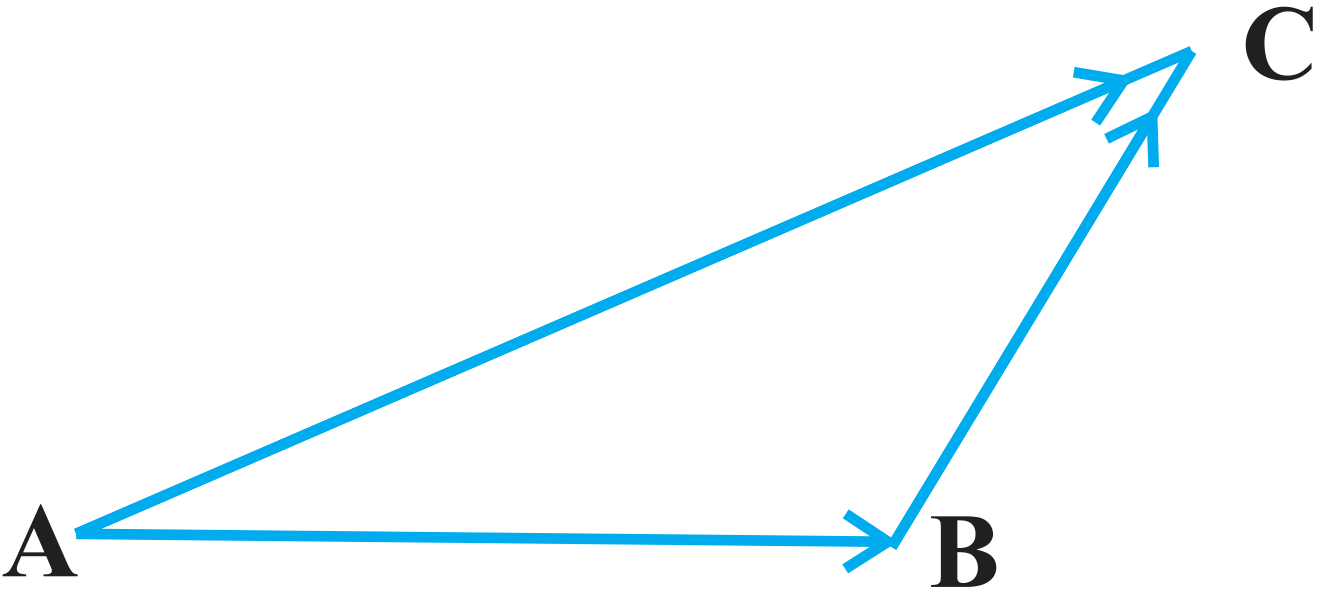
In triangle ABC (Fig 10.18), which of the following is not true:

  1. $\overrightarrow{\text{AB}}+\overrightarrow{\text{BC}}+\overrightarrow{\text{CA}}=\vec{0}$
  2. $\overrightarrow{\text{AB}}+\overrightarrow{\text{BC}}-\overrightarrow{\text{AC}}=\vec{0}$
  3. $\overrightarrow{\text{AB}}+\overrightarrow{\text{BC}}-\overrightarrow{\text{CA}}=\vec{0}$
  4. $\overrightarrow{\text{AB}}-\overrightarrow{\text{CB}}+\overrightarrow{\text{CA}}=\vec{0}$
If $A = \left[ {\begin{array}{*{20}{c}}1&2&3\\5&0&7\\6&2&5\end{array}} \right]$and $B = \left[ {\begin{array}{*{20}{c}}1&3&5\\0&0&2\end{array}} \right]$, then which of the following is defined