MCQ
If  $\begin{gathered} f(x)\, = \,\left\{ \begin{gathered}
  x\left( {\frac{{{e^{1/x}} - {e^{ - 1/x}}}}{{{e^{1/x}} + {e^{ - 1/x}}}}} \right)\,,\,\,x \ne 0 \hfill \\
  \,\,\,\,\,\,\,\,\,\,\,\,\,\,\,\,0\,\,\,\,\,\,\,\,\,\,\,\,\,\,\,\,\,\,\,\,\,\,\,\,\,\,\,\,\,\,\,\,\,\,\,,\,\,\,\,x\, = \,0\,\,\,\,\,\,\,\,\,\,\,\,\, \hfill \\ 
\end{gathered}  \right. \hfill \\
  \,\,\,\,\,\,\,\,\,\,\,\,\,\,\,\,\,\,\,\,\,\,\,\,\,\,\,\,\,\,\,\,\,\,\ \hfill \\ 
\end{gathered}$ then correct statement is
  • A
    $f$ is continuous at all points except $x = 0$
  • $f$ is continuous at every point but not differentiable
  • C
    $f$ differentiable at every point
  • D
    $f$ is differentiable only at the origin
Answer

Correct option: B.
$f$ is continuous at every point but not differentiable
b
$A+x=0;$

${\rm{LHD}} = \mathop {\lim }\limits_{h \to 0} \frac{{{\rm{f}}(0 - {\rm{h}}) - {\rm{f}}(0)}}{{ - {\rm{h}}}}$

$ = \mathop {\lim }\limits_{h \to 0} \frac{{ - h\left( {\frac{{{e^{ - 1/h}} - {e^{1/h}}}}{{{e^{ - 1/h}} + {e^{1/h}}}}} \right)}}{{ - h}}$

$ = \mathop {\lim }\limits_{h \to 0} \frac{{{e^{1/h}}}}{{{e^{1/h}}}}\left( {\frac{{{e^{ - 2/h}} - 1}}{{{e^{ - 2h}} + 1}}} \right)$

$\frac{{{e^{ - \infty }} - 1}}{{{e^{ - \infty }} + 1}} =  - 1$

${\rm{RHD}} = \mathop {\lim }\limits_{h \to 0} \frac{{{\rm{f}}(0 + {\rm{h}}) - {\rm{f}}(0)}}{{\rm{h}}}$

$ = \mathop {\lim }\limits_{h \to 0} \frac{{h\left( {\frac{{{e^{1/h}} - {e^{ - 1/h}}}}{{{e^{1/h}} + {e^{ - 1/h}}}}} \right) - 0}}{h} = 1$

Not differentiable but continuous

Need a full question paper?

Generate a complete, print-ready paper with questions like this in minutes — across 16+ boards, with answer keys.

Start Generating Free

Similar questions

If domain of function $f(x) = \sqrt {\ln \left( {m\sin x + 4} \right)} $ is $R$ , then number of possible integral values of $m$ is
If $m[-3 \text{ amp} ; 4] + n[-3 \text{ amp}; 4] = [10 \text{ amp} ;-11],$ then $3m + 7n =$
The area bounded by the curve $y = {x^3},$ $x - $ axis and two ordinates $x = 1$ to $x = 2$ equal to
Let $g$ is the inverse function of $f \,\&\, f ' (x) = \frac{{{x^{10}}}}{{\left( {1\,\, + \,\,{x^2}} \right)}}$. If $g(2) = a$ then $g ' (2)$ is equal to
Solve $\tan ^{-1} \frac{1-x}{1+x}=\frac{1}{2} \tan ^{-1} x,(x>0)$
Let $f(x)=\left\{\begin{array}{cl}x^2 \sin \left(\frac{1}{x}\right) & , x \neq 0 \\ 0 & , x=0\end{array} ;\right.$ Then at $x=0$
A man of height $2$ $metres$ walks at a uniform speed of $5\  km/hr$. away from a lamp post which is $6$ $metres$ high. Find the rate at which the length of his shadow increases ........... $km/hr$.
The value of the integral $\int\limits_0^{0.9} {[ - 2[x]]\,dx,} $ where $[.]$ denotes the greatest integer function is
Let $*$ be a binary operation defined on $Q^+$ by the rule $\text{a}^*\text{b}=\frac{\text{ab}}3\forall\text{ a, b}\in \text{Q}^+.$ The inverse of $4 ^* 6$ is:
 $(i)$  $f (x)$ is continuous and defined for all real numbers

$(ii)$ $f '(-5) = 0 \,; \,f '(2)$ is not defined and $f '(4)  = 0$

$(iii)$ $(-5, 12)$ is a point which lies on the graph of $f (x)$

$(iv)$ $f ''(2)$ is undefined, but $f ''(x)$ is negative everywhere else.

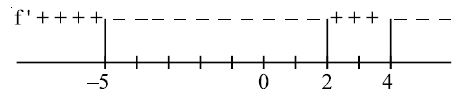
$(v)$ the signs of  $f '(x)$ is given below

On the possible graph of $y = f (x)$ we have